
Implementation of a Community Health Worker to Improve Engagement in First-Episode Psychosis Patients
Katlyne Dessaint-Louis, CHW¹, Morgan Ellis, MHS¹, Brittany Gouse, MD, MPH¹,², Anne Berrigan, LICSW¹, Ellie Reagan, MSW¹, Devin Cromartie Bodrick, MD, MPH¹,², Samantha LaMartine, PsyD¹,², Anissa Ray, CHW³, Hannah E. Brown, MD¹,²
¹ Wellness and Recovery After Psychosis (WRAP) Program, Boston Medical Center, Boston, MA
² Boston University Chobanian and Avedisian School of Medicine, Boston, MA
³ Boston Public Health Commission, Boston, MA
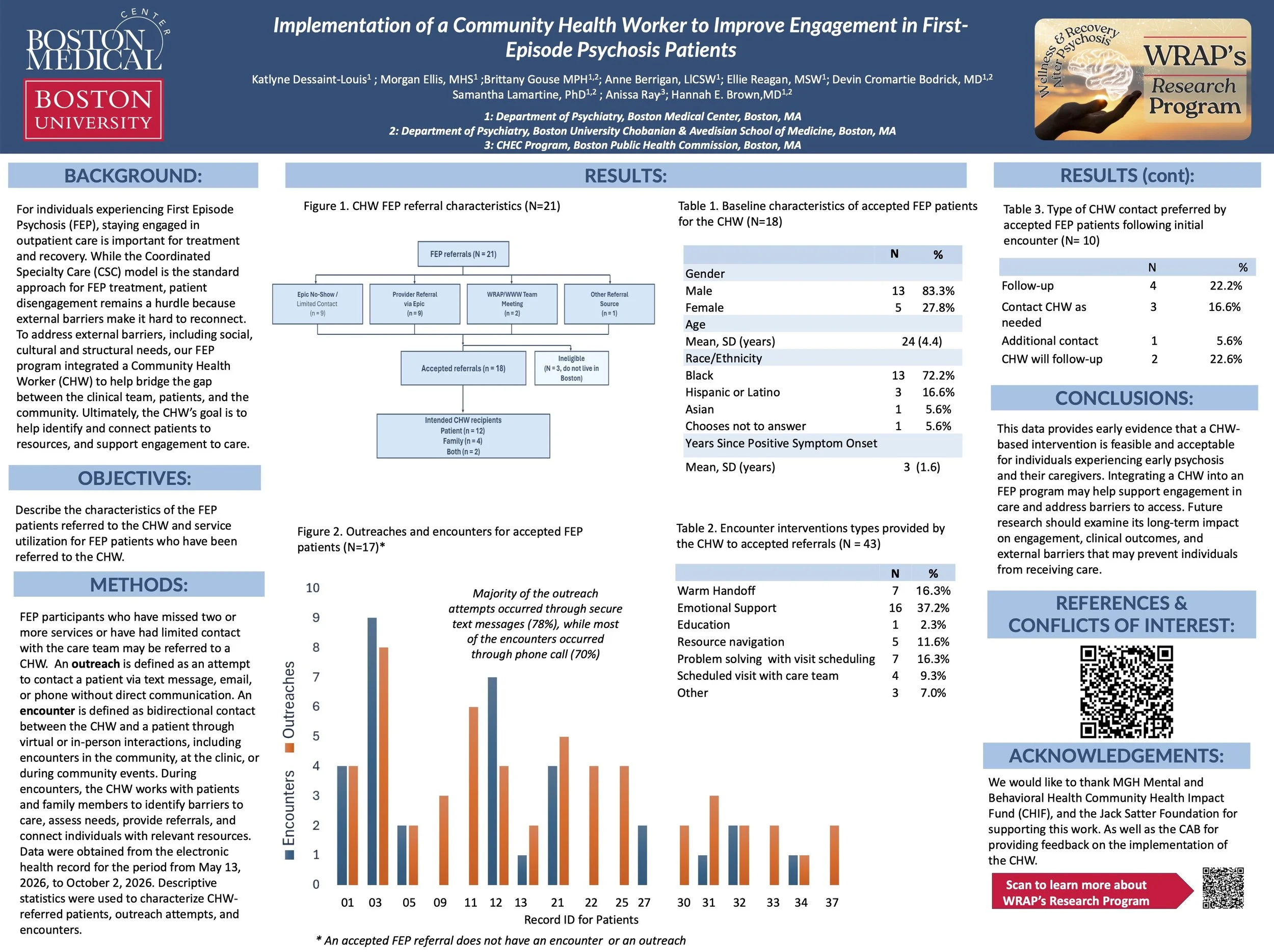
Background: For individuals with First-Episode Psychosis (FEP), engagement in outpatient care is essential. Although Coordinated Specialty Care (CSC) is the gold standard for FEP care, disengagement is a challenge that can worsen social functioning and quality of life, as outcome trajectories are often established early in the disorder. Studies show that integrating Community Health Workers (CHWs) into behavioral health settings can increase treatment engagement. However, research on CHWs' effects on FEP patients remains limited. To improve treatment engagement among individuals experiencing FEP, the Wellness Recovery After Psychosis (WRAP) Program integrated a CHW to reduce structural, cultural, and social barriers to treatment engagement.
Methods: WRAP program participants who have missed 2+ services or are identified through limited contact patient lists are referred to CHW services. After a patient is referred, the CHW outreaches via text, email, or phone call. The CHW can also meet with the patient or their family member in the community or clinic, during which time referrals are made, and they are connected to resources.
Results: There were 16 (43%) individuals referred to the CHW that met FEP criteria. Half of FEP referrals (n=8) came from the no-show list. Some referrals (n=3; 19%) were for the CHW to work with only the family. Text messages were the most common outreach method (71%). Most encounters were over the phone (77%) and lasted less than 10 minutes (58%). Key interventions provided included emotional support (46%) and problem-solving around visit scheduling (23%). Primarily, transportation was an ongoing barrier to care (63%). Most follow-up plans after the encounters were scheduled meetings (35%). The median number of encounters per patient was 2.5 (IQR = 1.3-4.0)
Conclusion: Integrating a CHW into a CSC program is feasible and may improve disengagement rates among FEP patients. Longer term follow-up is needed to determine the longitudinal benefits.