
The Impact of an Employment Specialist on Employment, Education, and Acute Care Use in First- Episode Psychosis: A Matched-Cohort Study at the RISE Clinic
Clifton Chow, PhD, Olivia Baker, Jamie Ye, M.D., Lynn E DeLisi, M.D.
The Psychosis Research Laboratory and RISE Clinic, Department of Psychiatry, Cambridge Health Alliance and Harvard Medical School, Cambridge, MA
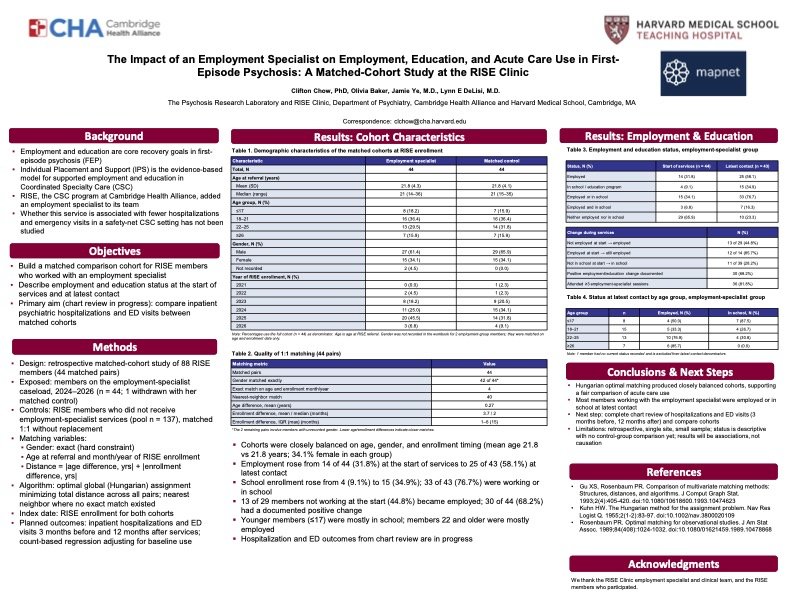
Background: Employment and educational support may improve recovery in psychosis and related mental health disability, but its contribution to First Psychotic Episode treatment in a Coordinated Specialty Care Clinic needs further research. This study will examine whether working with an employment specialist is associated with fewer inpatient hospitalizations and emergency room visits among RISE members.
Methods: Retrospective matched-cohort chart review of 90 RISE members: 45 who received employment-specialist services during 2024-2026, each matched 1:1 without replacement to a member who did not, on gender, age, and month/year of RISE entry. Gender matched exactly, with pairs selected by optimal global (Hungarian) assignment minimizing combined age and enrollment-date distance, using nearest neighbors where no exact match existed. The index date is RISE enrollment for both cohorts. Charts will be reviewed since inception, with descriptive analysis of the exposed cohort 3 months before and 12 months after intervention. Primary outcomes are inpatient psychiatric hospitalizations and emergency room visits; secondary outcomes may include any such encounter, total inpatient days, and time to first acute-care encounter. Count-based regression will compare baseline-to-follow-up change, adjusting for baseline utilization and clinical differences.
Results: Cohorts were closely balanced. Mean age was 21.6 (SD 4.3) years in the employment group and 21.7 (SD 4.1) in controls; 27 (60.0%) versus 30 (66.7%) were male and 15 (33.3%) in each female, with gender unrecorded for 3 exposed members. Mean matched difference was 0.3 years in age and 3.7 months in enrollment. Among the employment group, 25 of 44 with data recorded (56.8%) were currently employed and 16 of 44 (36.4%) currently in school.
Conclusion: This study will assess whether employment-specialist services are associated with reduced acute healthcare utilization among RISE members. Findings may inform integration of employment support into coordinated mental health services. Being observational, results are associations rather than causation.