
Expanding Access to Evidence-Based Resources: Crafting Support
Matthew Doherty (1), Julie M. McCarthy (1,2)
1. Division of Psychotic Disorders, McLean Hospital, Belmont, MA
2. Department of Psychiatry, Harvard Medical School
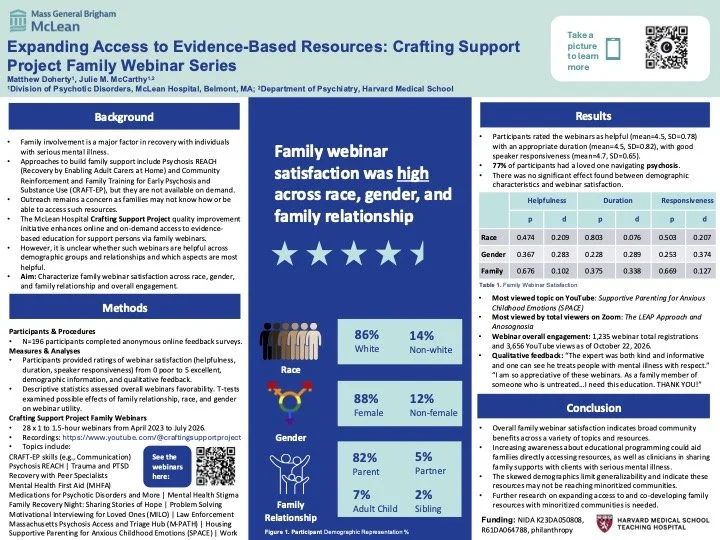
Background: Family involvement is a major factor in recovery for individuals with serious mental illness. Existing approaches to build family support include Psychosis REACH (Recovery by Enabling Adult Carers at Home) and Community Reinforcement and Family Training for Early Psychosis and substance use (CRAFT-EP). However, outreach remains a concern as families may not know how or be able to access these resources. The Crafting Support Project quality improvement initiative aims to enhance access to evidence-based education for support persons of loved ones navigating mental health recovery.
Methods: N=196 participants completed Crafting Support Project Family Webinar Series anonymous online feedback surveys from 28 webinars between 2023 and 2026. Participants provided ratings of webinar qualities (helpfulness, duration, speaker responsiveness) from 0 to 5, demographic information, and qualitative feedback. Descriptive statistics assessed overall webinars favorability. T-tests examined possible effects of family relationship, race, and gender on webinar utility.
Results: Participants rated the webinars as helpful (mean=4.5, SD=0.78) with an appropriate duration (mean=4.5, SD=0.82), with good speaker responsiveness (mean=4.7, SD=0.65). Participants were primarily parents (82%) identifying as white (86%) and female (88%). Participants’ loved one(s) most commonly experienced psychosis (43%). There was no significant effect of demographic characteristics on webinar ratings (p>.05). As of August 12, 2026, the webinars had 2,792 YouTube views with Communication Skills: Building Trust and Understanding being the most viewed topic.
Conclusion: Overall favorability of the webinars was high regardless of family role, race, or gender, indicating broad community benefits from outreach and support. Increasing awareness about such educational programming would also likely benefit mental health clinicians interested in sharing accessible family supports with their clients and their families. The sample’s skew regarding demographics limits generalizability of results and indicates these resources may not be reaching minoritized communities. Further research on developing family resources with minoritized communities is needed.