
Improving Violence Risk Assessment and Documentation in First Episode Psychosis (FEP): A Quality Improvement Initiative in Coordinated Specialty Care in RISE.
Yveton Isnor, PsyD, LMHC¹,²; Niharika Jhingan, MPH¹,²; Andrew Hyatt, MD¹,²; Norah Mulvaney-Day, PhD¹,²; Raquelle Mesholam-Gately, PhD¹,²; Lynn E. DeLisi, MD¹,²
¹ Psychosis Research Laboratory, Recovery in Shared Experiences (RISE), Department of Psychiatry, Cambridge Health Alliance, Cambridge, MA
² Harvard Medical School, Boston, MA
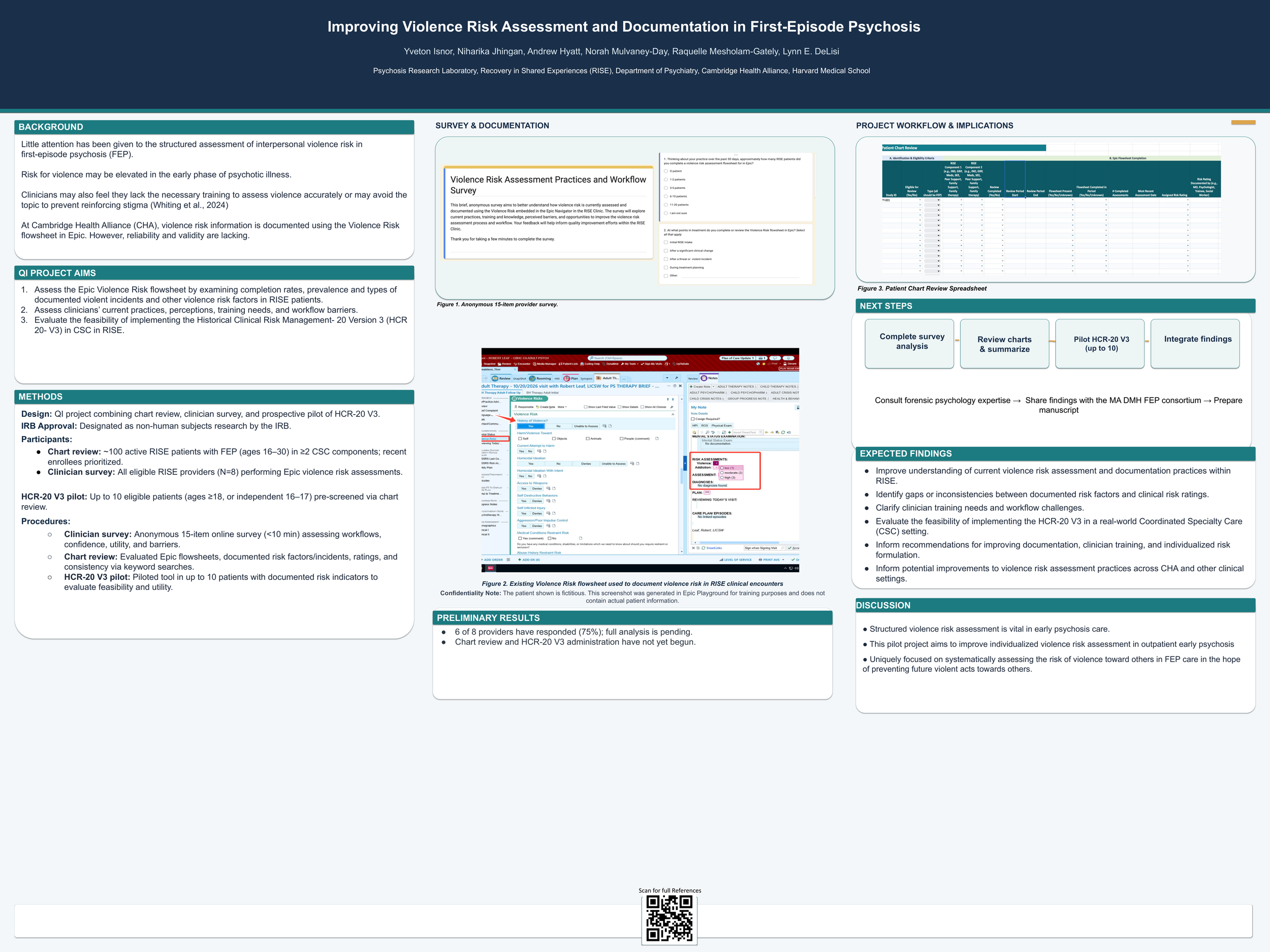
Background: Although considerable attention has been given to assessing suicide risk, less attention has been directed toward the systematic assessment of interpersonal violence risk in first-episode psychosis (FEP). Most individuals with FEP will not engage in violence; however, risk may be elevated during the early phase of psychotic illness. Within clinical settings, variability in assessment approaches and documentation may limit clinicians’ ability to identify clinically meaningful risk factors, develop individualized formulations, and implement appropriate risk-management strategies. This project aims to 1) examine how violent incidents are assessed and documented within the Recovery in Shared Experiences (RISE) coordinated specialty care clinic, and 2) assess the feasibility and clinical utility of implementing a structured professional judgment (SPJ) tool for violence risk assessment.
Methods: (1) chart review of approximately 100 active RISE FEP patients to examine completion of the existing Epic violence risk flowsheet and documentation of violence-related risk factors and incidents; (2) an anonymous semi-structured clinician survey assessing current practices, training, perceived barriers, and opportunities for workflow improvement; and (3) pilot administration of the Historical Clinical Risk Management-20, Version 3 (HCR-20 V3), a structured professional judgment tool, with up to 10 patients to evaluate feasibility, time burden, and clinical utility. The IRB determined the project to be exempt as a quality improvement project.
Results: While data collection and implementation are in the early phase, preliminary records review indicates that clinicians completed only a small portion of the Epic violence risk questionnaire. In addition, only a low percentage of patients expressed thoughts of harming other people, or committed a violent act, such as fighting, property destruction, or threats. Further anticipated findings will identify gaps and inconsistencies in current violence risk assessment and documentation, identify clinician training and workflow needs, and evaluate the feasibility and clinical utility of integrating the HCR-20 V3 into routine CSC practice.
Conclusion: This QI project aims to strengthen systematic, evidence-informed, and individualized approaches to assessing interpersonal violence risk in FEP within RISE. Findings will inform recommendations for improving clinical documentation, clinician training, risk formulation, and workflow practices within RISE and may provide a foundation for broader application with other early psychosis programs within the Massachusetts Psychosis Network for Early Treatment (MAPNET) and for future research.