
Long-Acting Injectable Antipsychotic Utilization and Prescriber-Reported Barriers Across a Safety-Net Health System
Brittany M. Gouse, Vincent Betti, Diana Kim, Joel Burt-Miller, Sarosh Khan, Destiny Montgomery, Danny Chen, Jessica Lewcyzk, Hannah E. Brown
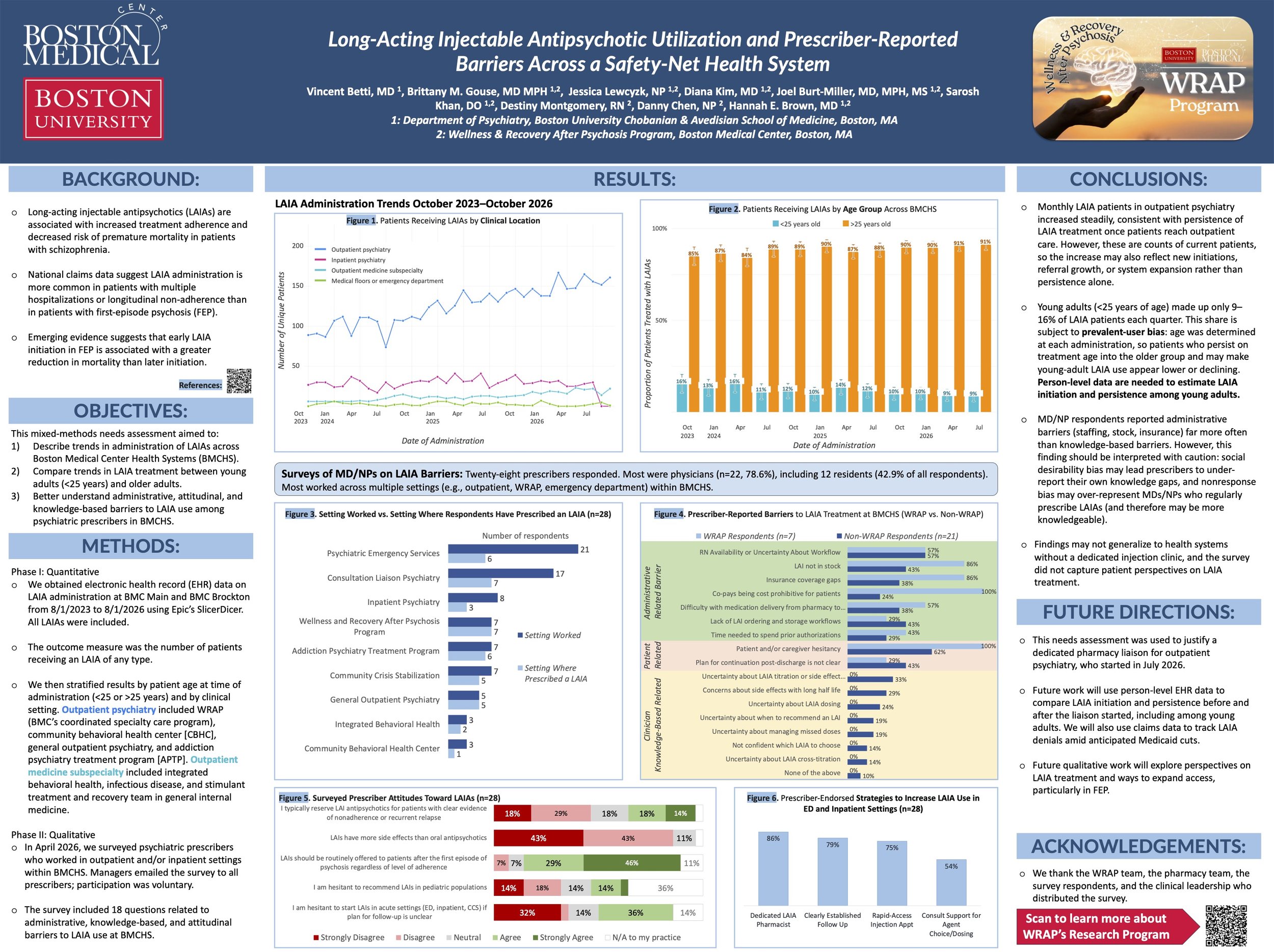
Background: Long-acting injectable antipsychotics (LAIAs) are associated with increased treatment adherence and decreased risk of premature mortality in schizophrenia. National claims data suggest LAIA administration is more common in patients with multiple hospitalizations or longitudinal non-adherence than first-episode psychosis (FEP) patients. Here, we report rates of and barriers to LAIA administration across Boston Medical Center Health System (BMCHS) alongside provider attitudes surrounding LAIA use in FEP.
Methods: First, we obtained electronic health record (EHR) data on LAIA administration across BMCHS from 8/1/2023 to 8/1/2026. LAIA administrations were stratified by patient age and clinical settings. Then, in April of 2026, psychiatrists and psychiatric nurse practitioners (NPs) across ambulatory, emergency, inpatient, and consult-liaison settings were surveyed on LAIA access, provider education barriers, and prescriber attitudes towards LAIAs.
Results: 7,108 LAIAs were administered across BMCHS from 2023 to 2026. Approximately 16.6% were received by patients under the age of 18 and 66.2% were by patients under the age of 30. LAIA administration was most common in outpatient (54.1%) and inpatient (22.4%) psychiatric settings. Administrative barriers were reported by 96% of the 28 providers that responded to the survey, with uncertainty surrounding nursing administration workflow (57%) and inadequate LAIA stock (54%) being most common. 75% of respondents agreed with LAIAs being offered to FEP patients. LAIA administration was uncommon in the emergency department (n=46, <1%) and on medical floors (n=58, <1%), with uncertainty surrounding follow-up as the most common barrier cited.
Conclusions: Our findings support that LAIAs are acceptable to young adults living with psychosis and prescribers within our health system, however the widespread use of LAIA in FEP is limited by insurance and access to specialty care-related barriers, particularly for patients seen in acute care settings. Future work will explore the impact of a dedicated pharmacy liaison on improving access to LAIA.