
Psychosis in Haitian Service Users: Cultural Idioms of Distress and Challenges in Clinical Care
Yveton Isnor, PsyD, LMHC¹,²; Andrew Hyatt, MD¹,²; Drew Madore, PsyD¹,²; Raquelle Mesholam-Gately, PhD¹,²; Lynn E. DeLisi, MD¹,²
¹ Psychosis Research Laboratory, Recovery in Shared Experiences (RISE), Department of Psychiatry, Cambridge Health Alliance, Cambridge, MA
² Harvard Medical School, Boston, MA
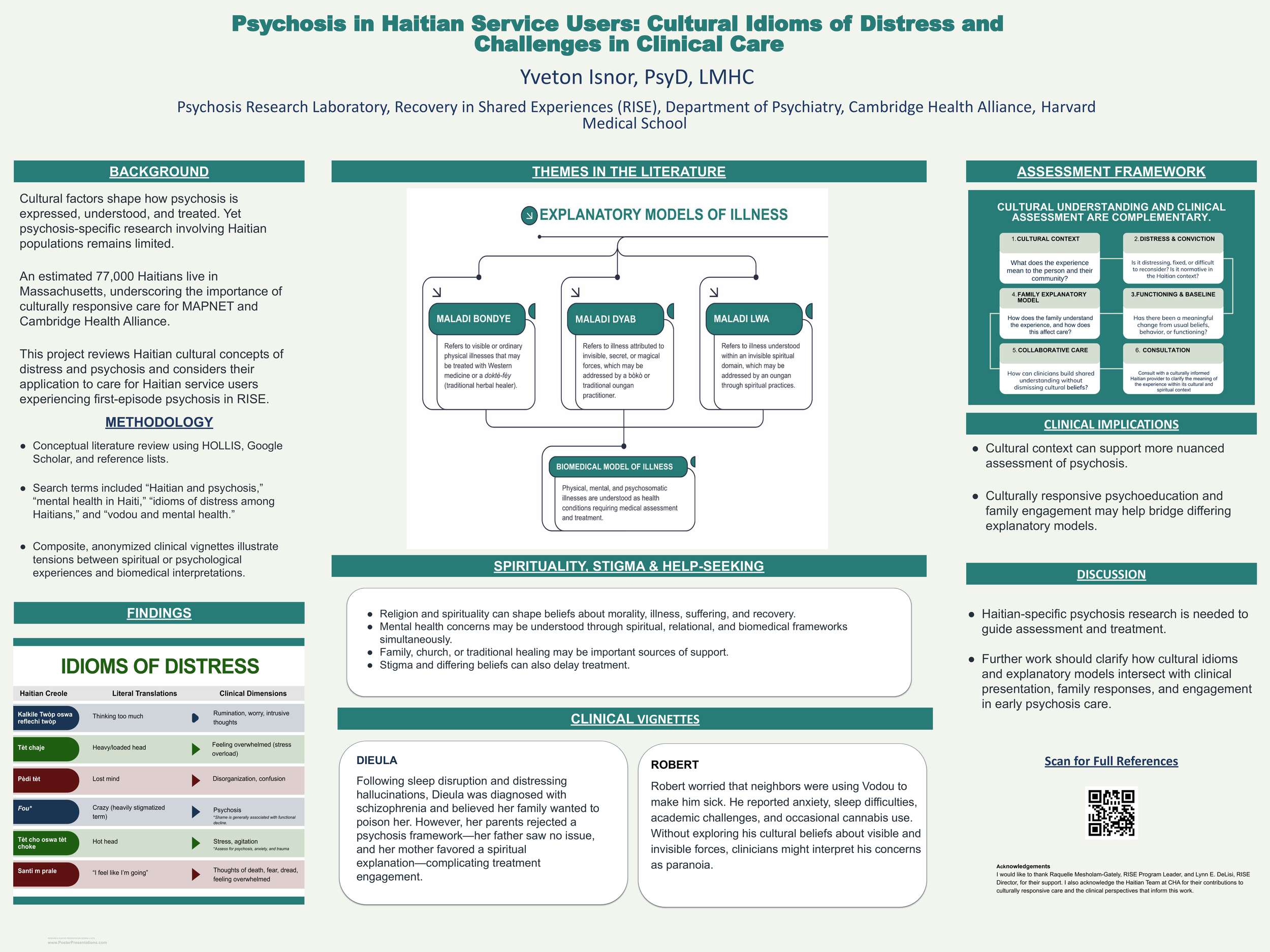
Background: Cultural factors are essential to the assessment and treatment of psychosis; however, psychosis-specific research regarding Haitian populations remains limited. An estimated 87,000 Haitians live in Massachusetts, making it an important population for Massachusetts Psychosis Network for Early Treatment (MAPNET) and Cambridge Health Alliance (CHA) to consider in efforts to improve psychosis care for this population. Existing literature on Haitian mental health describes culturally specific idioms of distress, explanatory models, religious and spiritual beliefs, language, and stigma that may influence how psychological experiences are expressed and interpreted. These factors may create challenges in distinguishing culturally meaningful experiences from psychotic symptoms and may influence help-seeking behavior, engagement, and family responses to care. This project aims to: 1) conceptually review literature on Haitian cultural concepts of psychosis and distress, explanatory models of psychosis, and culturally informed approaches to psychosis assessment and treatment within Haitian populations, and 2) examine how these concepts apply to the care of Haitian service users with first episode psychosis within the Recovery in Shared Experiences (RISE) coordinated specialty care program.
Methods: We searched HOLLIS, Google Scholar, and reference lists to gather relevant literature on mental health among Haitians. Search terms included “Haitian and psychosis,” “mental health in Haiti,” “idioms of distress among Haitians,” and “vodou and mental health.” A composite, anonymized clinical vignette was created based on Haitian service users in RISE to illustrate challenges when spiritual or psychological experiences overlap with features that may be interpreted as psychotic symptoms and when family explanatory models differ from biomedical understandings of psychosis.
Results: Current literature suggests a significant gap in psychosis-specific research involving Haitian populations. Existing work indicates that cultural and explanatory frameworks may influence symptom expression, help-seeking, treatment engagement, and interpretations of mental illness. The composite vignette highlights the importance of assessing cultural context, normative beliefs, distress, conviction, functional impairment, and changes from baseline when evaluating unusual experiences. It also illustrates the potential importance of culturally responsive psychoeducation and family involvement when explanatory models differ among service users, families, and clinicians.
Conclusion: Attention to cultural factors may support nuanced assessment and culturally responsive care for Haitian service users experiencing psychosis. Future research should examine psychosis phenomenology, family explanatory models, treatment engagement, and the role of Haitian Creole, culturally specific idioms, and religious views in clinical care.