
Trends and Provider Characteristics of GLP-1 Prescribing in First-Episode Psychosis
Sarosh Khan (1,2), Aviva G. Schwarz (1), Janice Weinberg (1,3), Brittany M. Gouse (1,2), Hannah E. Brown (1,2), Julia Browne (1,2)
1. Wellness and Recovery After Psychosis (WRAP) Program, Department of Psychiatry, Boston Medical Center Health System, Boston, Massachusetts, USA
2. Department of Psychiatry, Boston University Chobanian and Avedisian School of Medicine, Boston, Massachusetts, USA
3. Department of Biostatistics, Boston University School of Public Health, Boston, MA, USA
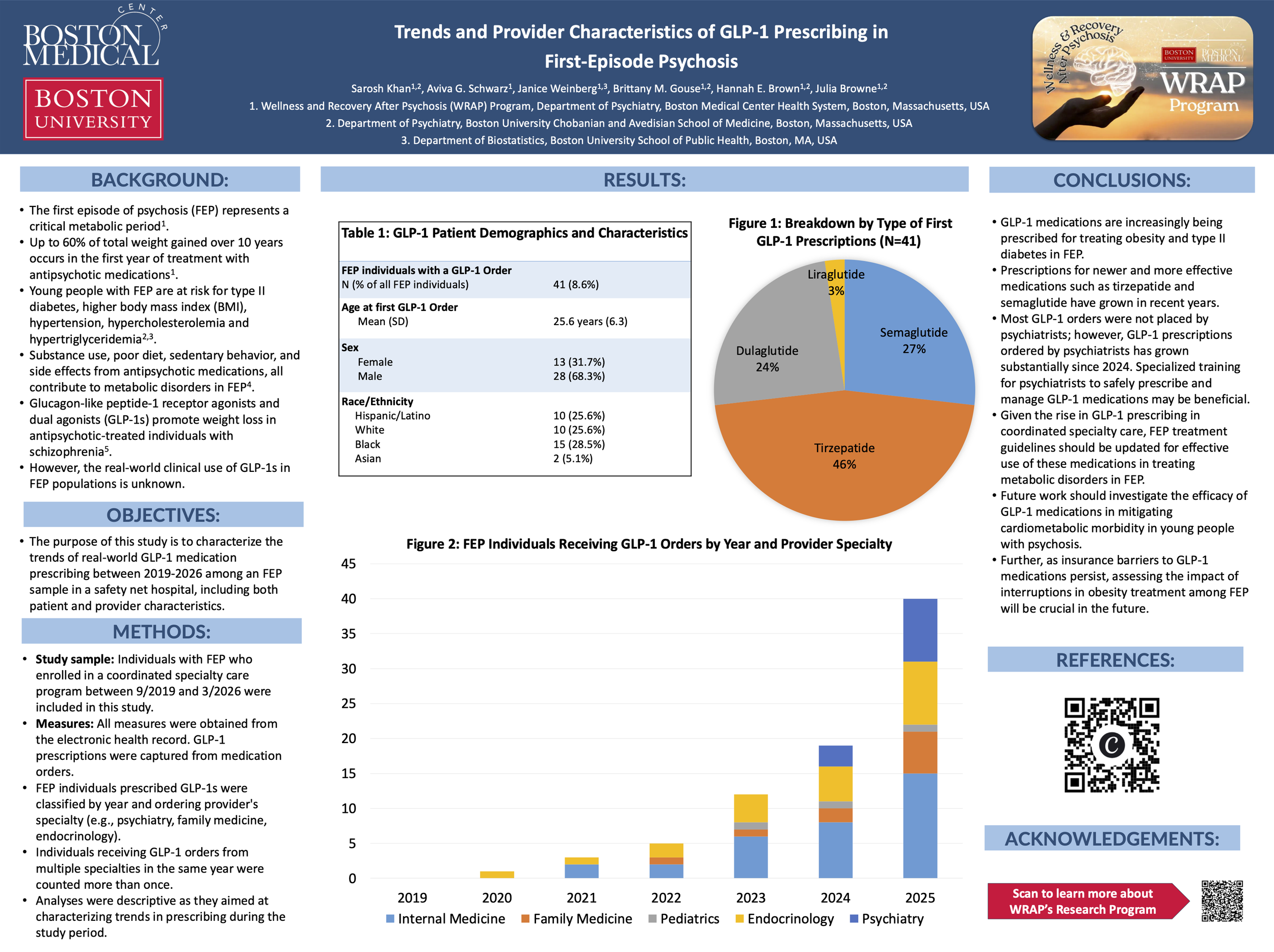
Background: The first episode of psychosis (FEP) represents a critical metabolic period, as the most rapid weight gain occurs within the first year of treatment. Glucagon-like peptide-1 receptor agonists and dual agonists (referred to collectively as GLP-1s) are efficacious for promoting weight loss in antipsychotic-treated individuals with schizophrenia. However, the real-world clinical use of GLP-1s in FEP samples is unknown. The purpose of this study is to characterize the trends of real-world GLP-1 medication prescribing between 2019-2026 among an FEP sample in a safety net hospital, including provider characteristics.
Methods: Study sample: Individuals with FEP who enrolled in a coordinated specialty care program between 9/2019 and 3/2026 were included in this study.
Measures: All measures were obtained from the electronic health record. GLP-1 prescriptions were captured from medication orders. Provider specialty (e.g., psychiatry, family medicine, endocrinology) associated with GLP-1 prescription orders were captured. Analyses were descriptive as they aimed at characterizing trends in prescribing during the study period.
Results: Overall, 41/475 individuals with FEP (8.6%) received a GLP-1 prescription. Total GLP-1 recipients rose from 0 in 2019 to 31 in 2025 and 16 in the first quarter of 2026. GLP-1 recipients were most commonly prescribed newer medications including tirzepatide (N = 28, 68%) and semaglutide (N = 19, 46.3%), and they most frequently received GLP-1 orders from primary care physicians (N = 19, 46.3%) and endocrinologists (N = 14, 34.1%); however, psychiatrist GLP-1 prescribing grew by 3-fold from 2024-2025.
Conclusions: Given the rise in GLP-1 prescribing in coordinated specialty care, FEP treatment guidelines should be updated to guide the effective use of these medications in treating metabolic disorders in FEP.