
Building Tomorrow's Leaders: Advancing Workforce Development in Early Psychosis Care through 2B-EPIC
Madeline Rivera Carranza¹; Lucia Flores¹; Jorge Delgado¹; Joey Rodriguez¹,²; Melanie Maldonado¹,²; Olivia Helfrich-Tapia¹,²; Vera Muñiz-Saurré¹,²; Michelle Friedman-Yakoobian¹,²; Kwame Dance¹,²
¹ Psychosis Research Program, Beth Israel Deaconess Medical Center, Boston, MA
² Department of Psychiatry, Harvard Medical School, Boston, MA
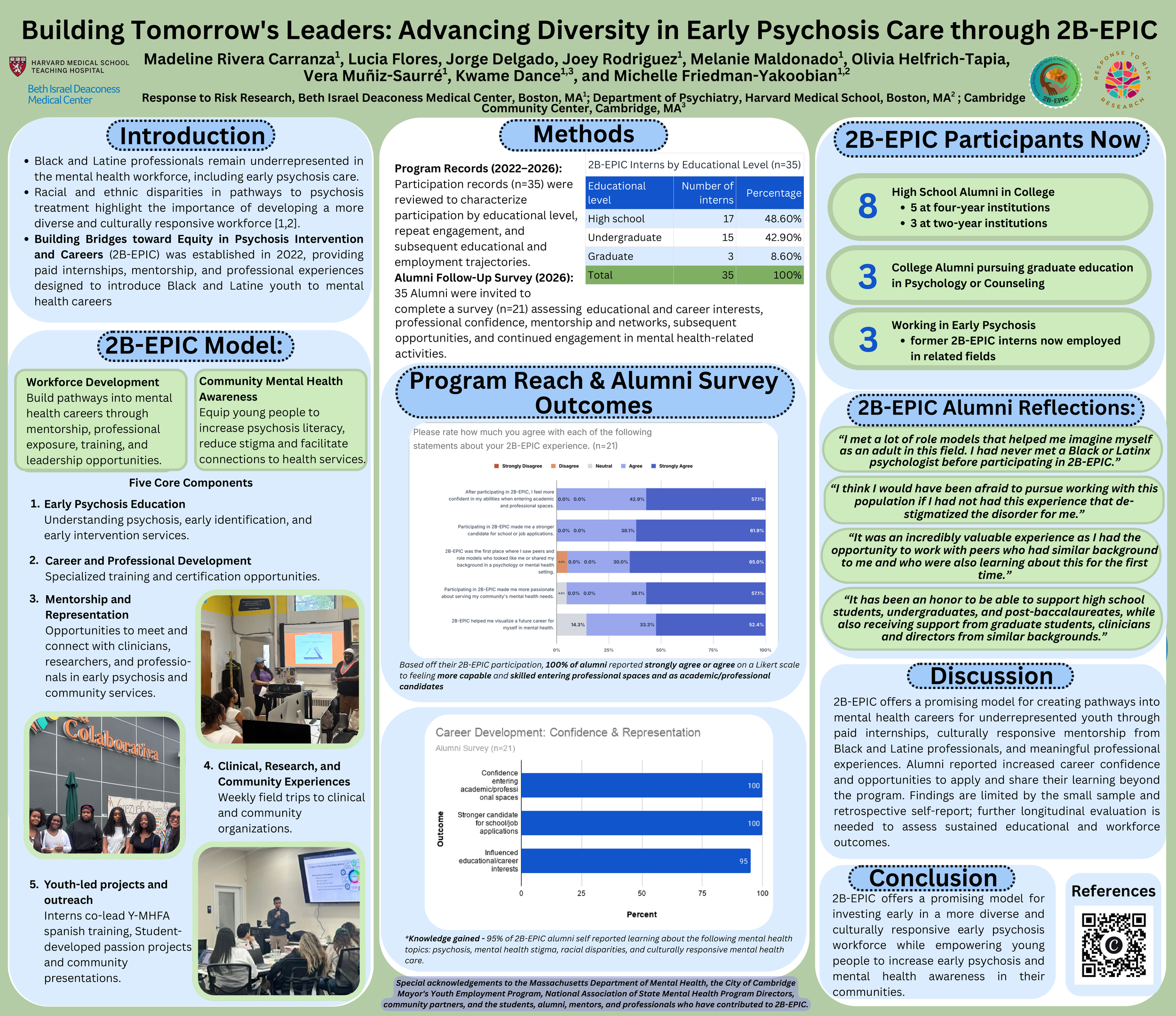
Background: Black and Latine professionals remain underrepresented in the mental health workforce, including among providers trained in early psychosis care. This gap is particularly concerning given persistent racial and ethnic disparities in pathways to early psychosis treatment, including greater likelihood of crisis-driven and coercive pathways to care. Building Bridges toward Equity in Psychosis Intervention and Careers (2B-EPIC) was established in 2023 to address this workforce gap upstream by exposing Black and Latine youth to mental health careers and providing experiences, mentorship, and professional connections designed to support their entry into the field.
Methods: 2B-EPIC provides paid internships combining early psychosis education, career and professional development, mentorship, research exposure, community and clinical field experiences, and youth-led passion projects. We examined program reach and participation from 2023–2026, including repeat participation and progression into mentoring, employment, and other advanced roles. In 2026, alumni were invited to complete a follow-up survey assessing educational and employment trajectories, professional networks, career direction and confidence, subsequent opportunities, continued involvement in mental health and related fields, and perceived influence of 2B-EPIC on their development. Exploratory pre/post data on psychosis knowledge and confidence connecting youth to care were also collected from a small subset of recent participants.
Results: We will report cumulative participation and continued engagement in 2B-EPIC from 2023–2026. Alumni findings will describe current education and employment, pursuit of mental health and related careers, subsequent internships and employment opportunities, professional network development, and career confidence. We will also examine alumni perceptions of whether 2B-EPIC helped clarify career goals, build connections, increase access to opportunities, and prepare them for subsequent educational and professional experiences. Participant reflections will illustrate pathways from initial participation to later opportunities and leadership roles.
Conclusion: Findings will examine the potential of paid internships, mentorship, professional exposure, and progressive leadership opportunities to support Black and Latine youth along pathways into mental health careers. 2B-EPIC may provide a promising model for investing early in the workforce pipeline to strengthen diversity and cultural responsiveness in early psychosis care.