
Early onset psychosis (EOP) patients show widespread cognitive impairment and specific cognitive lags in verbal and nonverbal speed
Rachel Kraff¹, Margot Austin¹, Montserrat Nieto¹, Dahlia Kirov¹, Emma Deaso¹, Samuel Mathias¹,², Amanda Rodrigue¹,², Emma Knowles¹,², Catherine Brownstein¹, Eugene D’Angelo¹, Joseph Gonzalez-Heydrich¹, David Glahn¹,², Josephine Mollon¹,²
¹ Department of Psychiatry and Behavioral Sciences, Boston Children’s Hospital, Boston, MA
² Department of Psychiatry, Harvard Medical School, Boston, MA
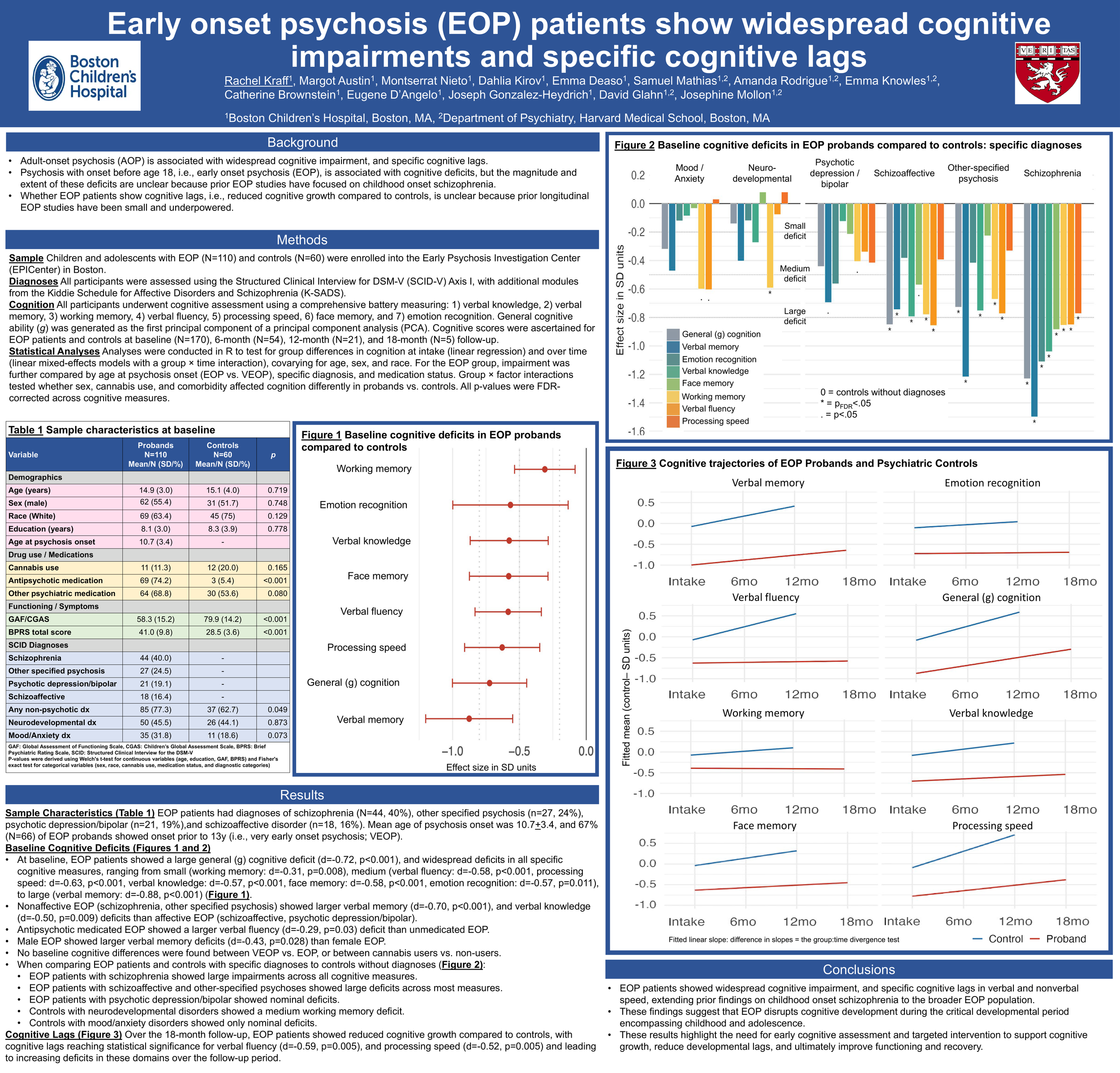
Background: Psychosis with onset <18y, (early-onset psychosis; EOP), is associated with cognitive deficits. Yet, the extent of these deficits is unclear, as prior studies have focused on childhood-onset schizophrenia. Moreover, there are limited data clarifying whether EOP patients show cognitive lags.
Methods: Children/adolescents with EOP (N=110) and controls (N=60) participated. EOP patients had SCID diagnoses of schizophrenia (N=44, 40%), other specified psychosis (n=27, 24%), schizoaffective disorder (n=18, 16%), and psychotic depression/bipolar (n=21, 19%). Age of psychosis onset was 10.5+3.3y, and 67% (N=66) showed onset prior to 13y (very early onset psychosis; VEOP). Participants underwent cognitive assessment measuring: verbal knowledge, verbal memory, working memory, verbal fluency, processing speed, face memory, and emotion recognition. General cognitive ability (g) was generated as the first principal component of a PCA. Data were collected at baseline (N=172), 6-month (N=54), 12-month (N=20), and 18-month (N=5) follow-up. Baseline cognitive deficits, and cognitive lags (time-by-group interactions) in EOP compared to controls were tested.
Results: At baseline, EOP patients showed a large general deficit (d=-0.72, p<0.001) and small to large deficits in all specific measures: working memory: d=-0.31, p=0.008, verbal fluency: d=-0.58, p<0.001, processing speed: d=-0.63, p<0.001, verbal knowledge: d=-0.57, p<0.001, face memory: d=-0.58, p<0.001, emotion recognition: d=-0.57, p=0.011, and verbal memory: d=-0.88, p<0.001. Nonaffective EOP showed larger verbal memory (d=-0.70, p<0.001) and knowledge (d=-0.50, p=0.009) deficits than affective EOP. Antipsychotic medicated vs. nonmedicated EOP showed larger verbal fluency deficits (d=-0.29, p=0.03). Male vs. female EOP showed larger verbal memory deficits (d=-0.43, p=0.028). Throughout 18-month follow-up, EOP patients showed reduced cognitive growth compared to controls, with cognitive lags in verbal fluency (d=-0.59, p=0.005) and processing speed (d=-0.52, p=0.005), leading to increasing deficits over the follow-up period.
Conclusion: EOP patients showed widespread impairment and specific cognitive lags. These findings high-light the need for early identification/intervention to support cognitive growth/reduce developmen-tal lags and improve outcomes.