
Trends and Provider Characteristics of GLP-1 Prescribing in First-Episode Psychosis
Sarosh Khan, DO¹,²; Aviva G. Schwarz, MPH¹; Janice Weinberg, ScD¹,³; Brittany M. Gouse, MD, MPH¹,²; Hannah E. Brown, MD¹,²; Julia Browne, PhD¹,²
¹ Wellness and Recovery After Psychosis (WRAP) Program, Department of Psychiatry, Boston Medical Center Health System, Boston, Massachusetts, USA
² Department of Psychiatry, Boston University Chobanian and Avedisian School of Medicine, Boston, Massachusetts, USA
³ Department of Biostatistics, Boston University School of Public Health, Boston, MA, USA
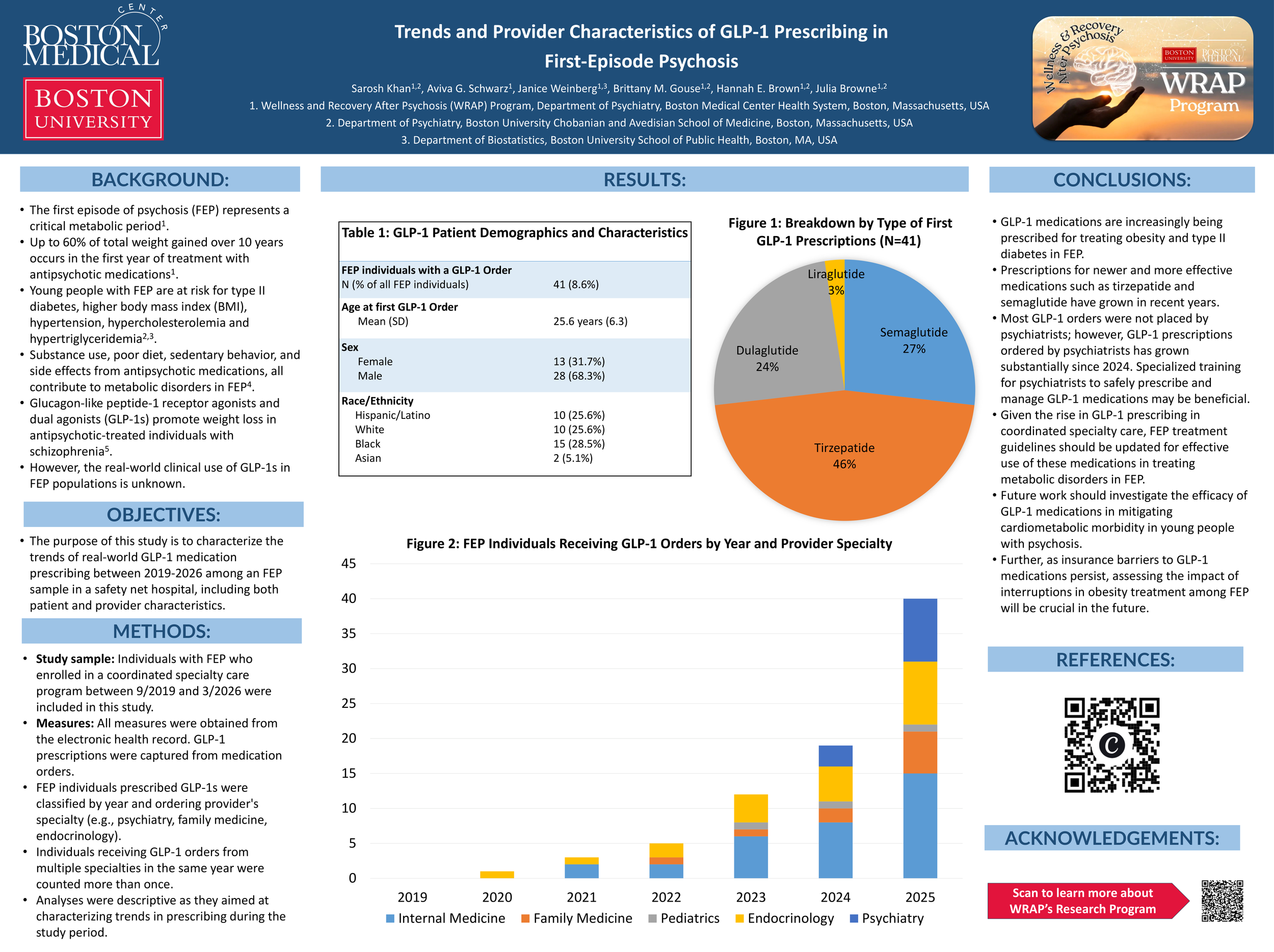
Background: The first episode of psychosis (FEP) represents a critical metabolic period, as the most rapid weight gain occurs within the first year of treatment. Glucagon-like peptide-1 receptor agonists and dual agonists (referred to collectively as GLP-1s) are efficacious for promoting weight loss in antipsychotic-treated individuals with schizophrenia. However, the real-world clinical use of GLP-1s in FEP samples is unknown. The purpose of this study is to characterize the trends of real-world GLP-1 medication prescribing between 2019-2026 among an FEP sample in a safety net hospital, including provider characteristics.
Methods: Study sample: Individuals with FEP who enrolled in a coordinated specialty care program between 9/2019 and 3/2026 were included in this study.
Measures: All measures were obtained from the electronic health record. GLP-1 prescriptions were captured from medication orders. Provider specialty (e.g., psychiatry, family medicine, endocrinology) associated with GLP-1 prescription orders were captured. Analyses were descriptive as they aimed at characterizing trends in prescribing during the study period.
Results: Overall, 41/475 individuals with FEP (8.6%) received a GLP-1 prescription. Total GLP-1 recipients rose from 0 in 2019 to 31 in 2025 and 16 in the first quarter of 2026. GLP-1 recipients were most commonly prescribed newer medications including tirzepatide (N = 28, 68%) and semaglutide (N = 19, 46.3%), and they most frequently received GLP-1 orders from primary care physicians (N = 19, 46.3%) and endocrinologists (N = 14, 34.1%); however, psychiatrist GLP-1 prescribing grew by 3-fold from 2024-2025.
Conclusion: Given the rise in GLP-1 prescribing in coordinated specialty care, FEP treatment guidelines should be updated to guide the effective use of these medications in treating metabolic disorders in FEP.