
Group-based lifestyle intervention for young adults with first-episode psychosis: Results from a pilot study
Cerelia Liu¹,²; Haniya Rizwan¹; Isabella Zhang¹; Gabrielle Simons³; Amelia C. Blanton¹; Noah Green¹; Jonathan Sugarman¹; Jason Walsh¹; Olivia Thomas³; Janice Weinberg¹,⁴; Julia Browne¹,²; Hannah E. Brown¹,²
¹ Wellness and Recovery after Psychosis Program, Department of Psychiatry, Boston Medical Center, Boston, MA, USA
² Chobanian and Avedisian School of Medicine at Boston University, Boston, MA
³ Nourishing Our Community Program, Boston Medical Center, Boston, MA, USA
⁴ Department of Biostatistics, Boston University School of Public Health, Boston, MA, USA
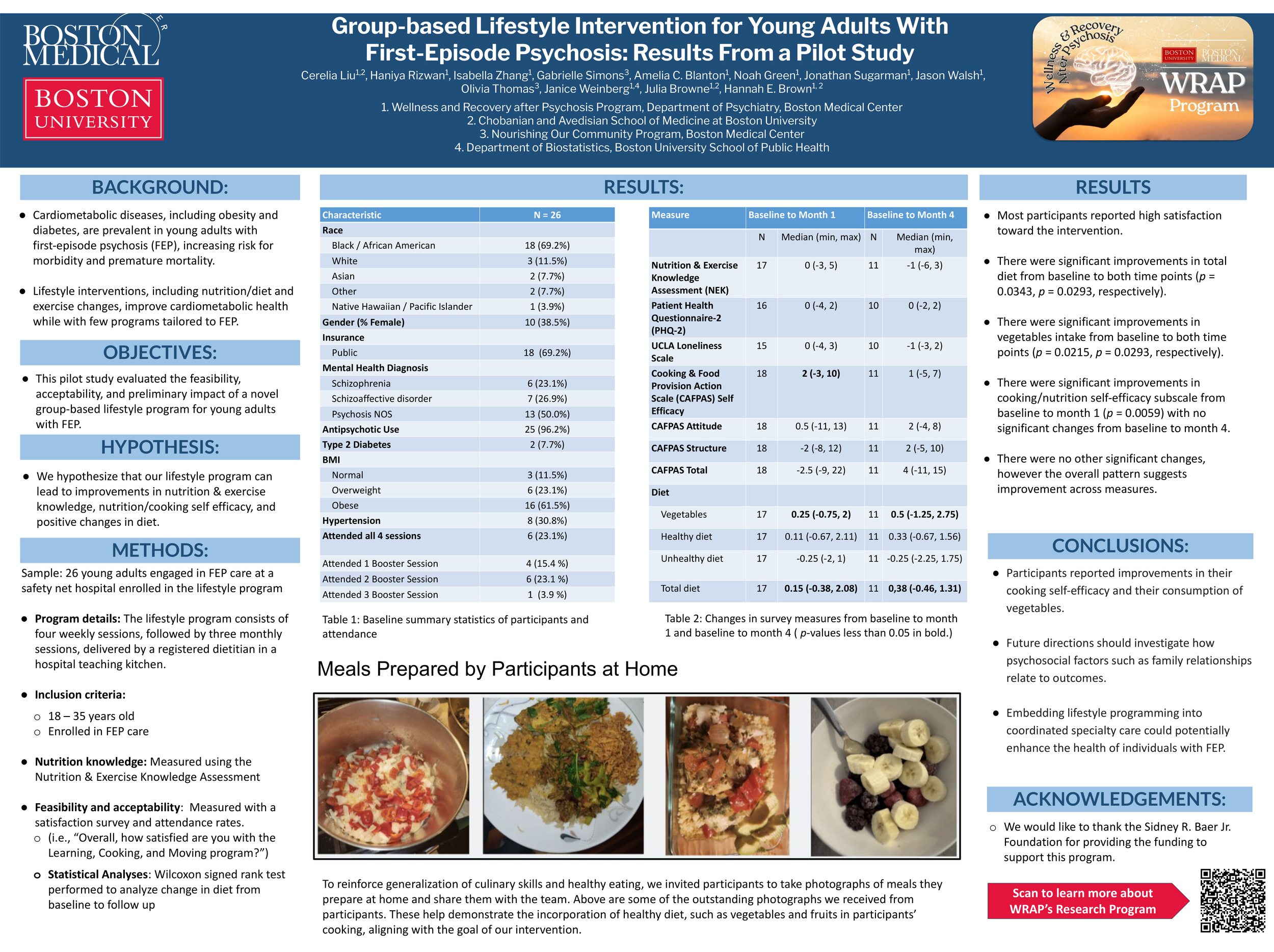
Background: Cardiometabolic diseases (e.g., obesity, diabetes) are prevalent in young adults with first-episode psychosis (FEP), increasing risk for premature mortality. Lifestyle interventions improve cardiometabolic health; however, few programs focus on this population. This pilot study evaluated the feasibility, acceptability, and preliminary impact of a novel group-based lifestyle program for young adults with FEP.
Methods: The lifestyle program involved hands-on culinary skills training, nutrition education, and physical activity delivered by a registered dietitian in a hospital teaching kitchen. Participants received four weekly classes followed by three monthly booster sessions. Participants completed assessments of nutrition knowledge (Nutrition & Exercise Knowledge Assessment) and nutrition/cooking self-efficacy (Cooking and Food Provisioning Action Scale/CAFPAS) at baseline, one month, and four months. Feasibility and acceptability were measured with a satisfaction survey and attendance rates. Cohen’s d effect sizes were calculated to characterize changes in nutrition knowledge and nutrition/cooking self-efficacy.
Results: The study sample included 26 young adults with FEP who were, on average, 25 years old (SD=3.3) and 61.5% male. Nearly all participants (25/26; 96%) attended at least 2/4 weekly classes, and 50% attended at least 3/4 weekly classes. Participants reported high satisfaction with the program (Total Score mean=12.6; SD=3.60; highest possible score = 15).
Of the participants with complete baseline and month one data, small effect size improvements were observed in nutritional knowledge (d=0.26, n=16) and total cooking/nutrition self-efficacy (d=0.15, n=18). There was a large effect size improvement on the cooking/nutrition self-efficacy subscale (d=0.78); however, scores on the other two subscales (attitudes towards cooking/nutrition and structure/meal planning and organization) did not change or worsened (d=-0.06, d=-0.24, n=18).
Conclusion: Results from this pilot study support initial feasibility and acceptability of a novel group-based lifestyle intervention for young adults with FEP. Future work should include larger, randomized trials to evaluate the efficacy and implementation of the lifestyle program.