
Metacognitive Reflection and Insight Therapy (MERIT) in First-Episode Psychosis Care: A Conceptual Framework
Sebastián Marcos Hernández-Del Valle¹,²,⁴; Ashley Buchanan-Nguyen¹,³,⁴,⁵,⁶; Faith Breisblatt¹,³; Tatiana Bennett¹,²,⁴,⁵; Emily Gagen⁴,⁵,⁶
¹ Advancing Services for Psychosis Integration and Recovery (ASPIRE) Clinic, Beth Israel Deaconess Medical Center (BIDMC), Boston, MA
² Massachusetts Mental Health Center, Department of Mental Health, Boston, MA
³ Department of Psychiatry, BIDMC, Boston, MA
⁴ Department of Psychiatry, Harvard Medical School, Boston, MA
⁵ The Brookline Center for Community Mental Health, Brookline, MA
⁶ Massachusetts Psychosis Access and Triage Hub (M-PATH), Brookline, MA
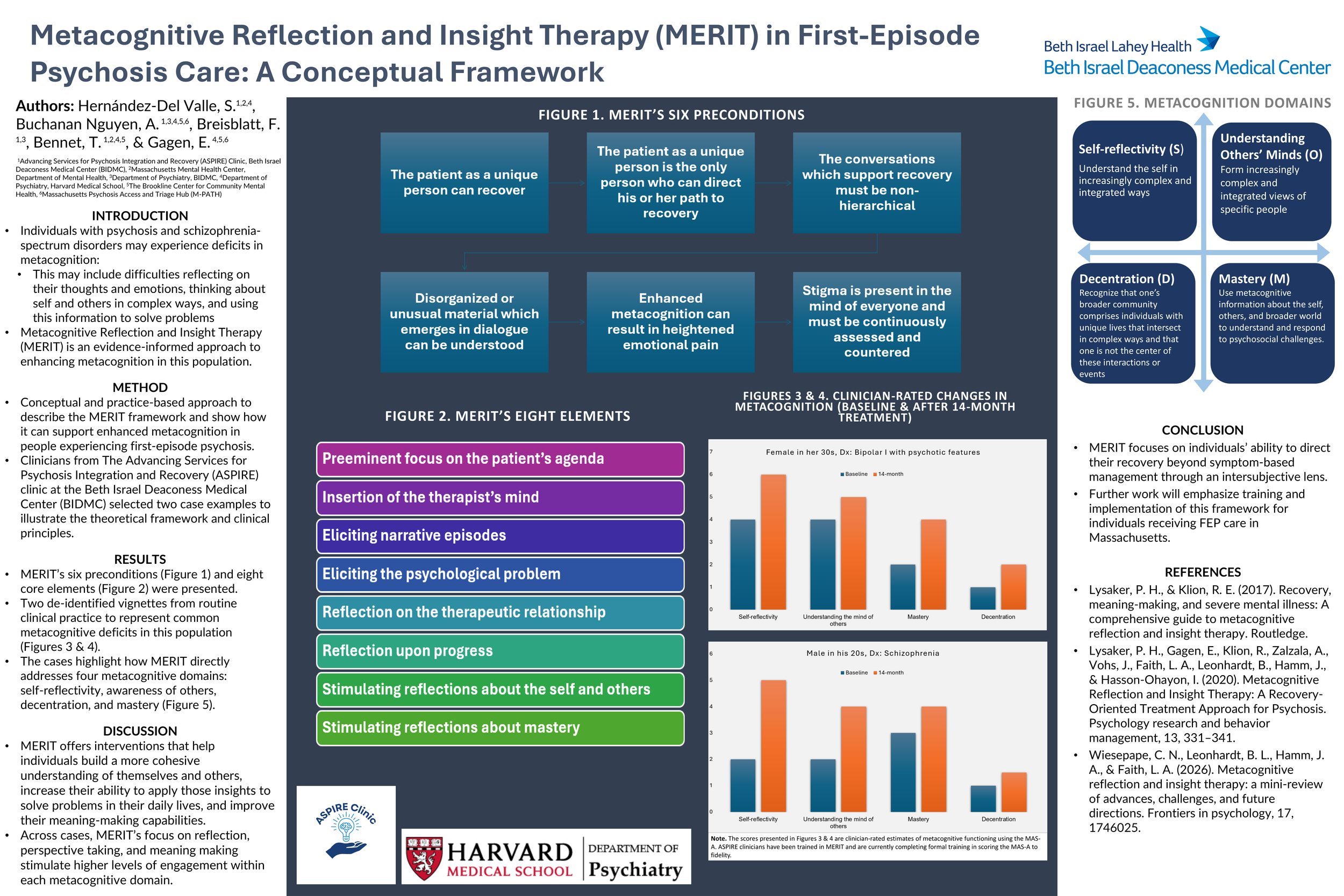
Background: Individuals recovering from psychosis and schizophrenia-spectrum disorders may experience deficits in metacognition, including difficulties reflecting on their thoughts and emotions and using this information to effectively solve problems. Metacognitive Reflection and Insight Therapy (MERIT) is an evidence-informed approach to enhancing metacognition in this population, offering interventions that help individuals build a more cohesive understanding of themselves and others, increase their ability to apply those insights to solve problems in their daily lives, and improve their meaning-making capabilities.
Method: This poster uses a conceptual and practice‑based approach to describe the MERIT framework and show how it can support enhanced metacognition in people experiencing first-episode psychosis (FEP). Clinicians from The Advancing Services for Psychosis Integration and Recovery (ASPIRE) clinic at the Beth Israel Deaconess Medical Center (BIDMC) selected two case examples to illustrate the theoretical framework and clinical principles.
Results: MERIT’s six preconditions and eight core elements were presented, as well as two de‑identified vignettes from routine clinical practice to represent common metacognitive deficits in this population. The cases highlight how MERIT directly addresses four metacognitive domains: self‑reflectivity, awareness of others, decentration, and mastery.
Discussion: MERIT is an evidence-informed and established intervention to provide clinical support to individuals recovering from FEP and schizophrenia-spectrum disorders at FEP clinics across the state of Massachusetts. The framework and vignettes help illustrate how MERIT’s principles can be applied to common metacognitive challenges in psychosis. Across cases, MERIT’s focus on reflection, perspective taking, and meaning making stimulate higher levels of engagement within each metacognitive domain.
Conclusion: MERIT focuses on individuals’ ability to direct their recovery beyond symptom-based management through an intersubjective lens. Further work will emphasize training and implementation of this framework for individuals receiving FEP care in Massachusetts.