
Personalizing Supported Employment and Education Services for First-Episode Psychosis in a Safety Net Hospital
Peggy Williams, BS¹; Noah Green, BA¹; Isabella Zhang¹; Evan Myers, PhD¹,²; Haniya Rizwan¹; Ellen Reagan, MSW¹; Hannah E. Brown, MD¹,²; Julia Browne, PhD¹,²
¹ Wellness and Recovery After Psychosis (WRAP) Program, Department of Psychiatry, Boston Medical Center Health System, Boston, Massachusetts, USA
² Department of Psychiatry, Boston University Chobanian and Avedisian School of Medicine, Boston, Massachusetts, USA
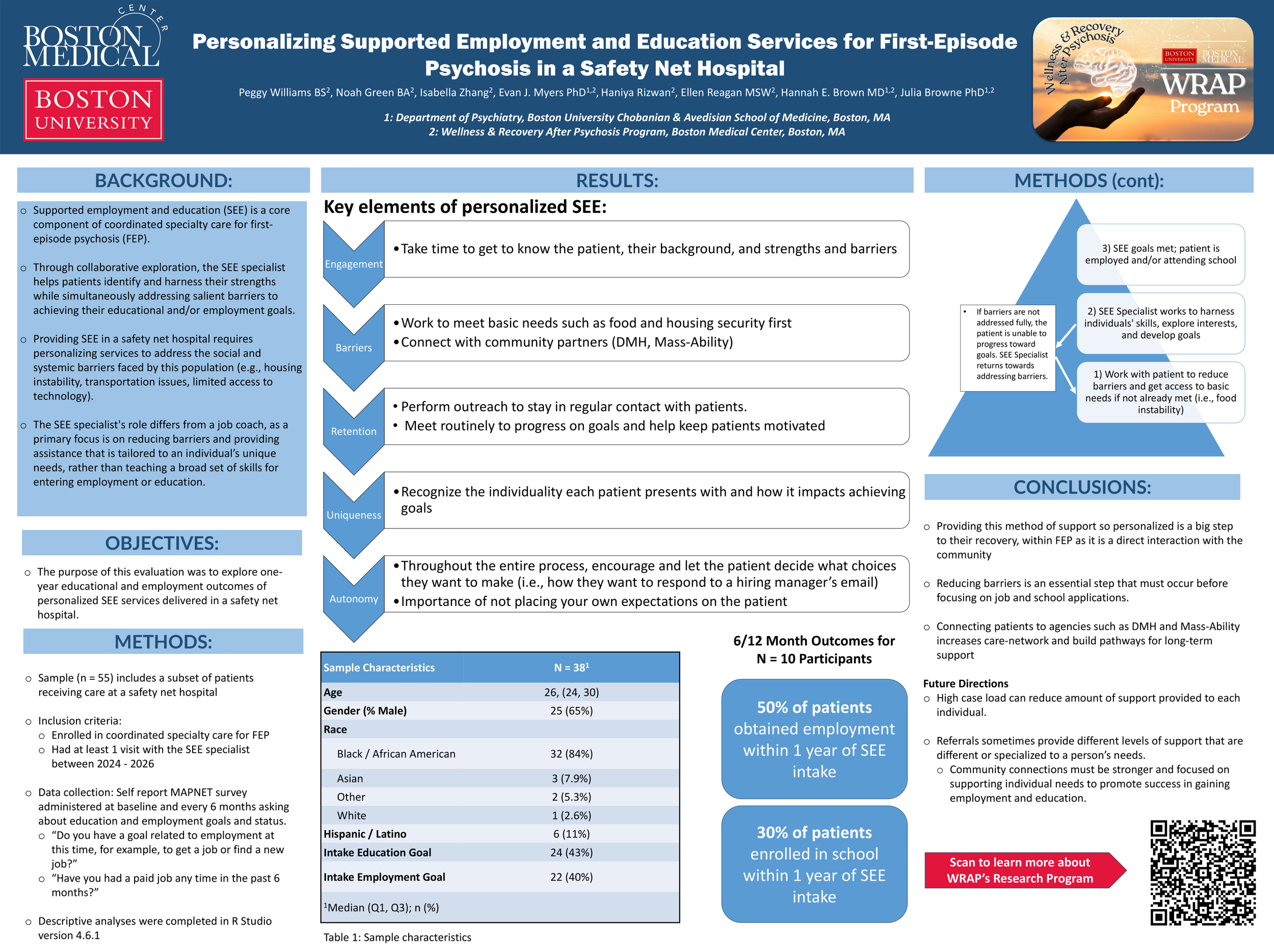
Background: Supported employment and education (SEE) is a core component of coordinated specialty care for first-episode psychosis (FEP). Personalized SEE services assist individuals in achieving their employment and educational goals through a person-centered approach. Through collaborative exploration, the SEE specialist helps patients identify and harness their strengths while simultaneously addressing salient barriers to achieving their goals. Providing SEE in a safety net hospital requires personalizing services to address the social and systemic barriers faced by this population (e.g., housing instability, transportation issues, limited access to technology). The purpose of this evaluation was to explore one-year educational and employment outcomes of personalized SEE services delivered in a safety net hospital.
Methods: The sample included individuals with FEP who enrolled in a coordinated specialty care program between 2024 and 2026 and had at least one session with the SEE specialist. Demographic and employment/education measures were obtained from the MAPNET standardized battery. Education and employment data were examined at SEE intake and at 6 and 12 months following the SEE intake.
Results: The sample comprised n=38 individuals with FEP (66% male, Average age = 27.1 years old, 84% Black or African American). At SEE intake, 78% reported a goal of obtaining employment and 65% reported a goal of attending school. Of those with 6 and/or 12 month data (n=10), 50% obtained employment and 30% enrolled in school.
Conclusion: Having work- and school-related goals were common among individuals with FEP who enrolled in SEE. Of the small number with follow-up data, most enrolled in school and/or obtained employment.
An SEE specialist at a safety net hospital is essential to address barriers impacting achievement of work- and school-related goals. Future work should explore barriers to achieving work- and school-related goals as well as effective strategies to overcome such challenges.