
Same Symptoms, Different Stories: Differential Relations of Suicidal Ideation and Childhood Maltreatment to Psychopathology Among Sexual and Gender Minority Youth
Peehu Chhabra¹; Alexa Marie Rivas¹; Kaitlin Ann Shannon¹; Angela Karanja¹; Kaesyn Price¹; Kathryn Eve Lewandowski¹; Zachary B Millman¹
¹ Division of Psychotic Disorders, McLean Hospital/Harvard Medical School
Background: Sexual and gender minority (SGM) youth are overrepresented in psychosis-risk clinical populations and face markedly elevated suicide risk. Early-intervention services typically monitor anxiety, depression, and psychosis-risk symptoms as warning signs for suicidal ideation. However, minority stress theory predicts that identity-based stressors may alter how symptoms relate to one another. If pathways to suicidal ideation differ by identity, screening calibrated to majority populations may miss the SGM patients at greatest risk.
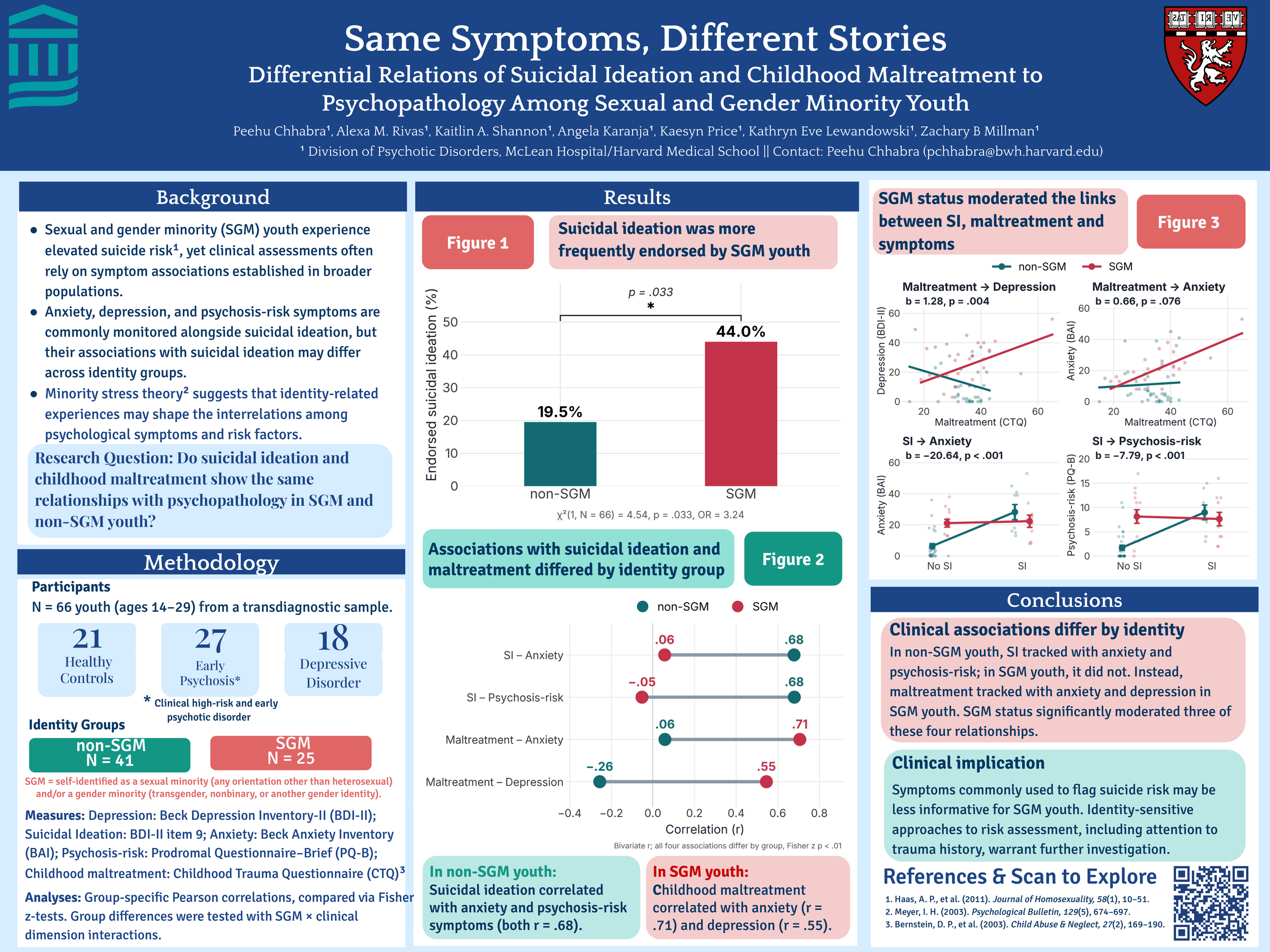
Methods: Sixty-six youth (ages 14–29) from a transdiagnostic sample (healthy controls n=21, clinical high-risk for psychosis n=27, depressive disorder n=18) were assessed on depression, anxiety, psychosis-risk, childhood maltreatment, and suicidal ideation. Correlation structures were compared across identity groups using Fisher z-tests, and maltreatment-to-depression moderation was tested via linear regression.
Results: SGM youth (n=25) endorsed suicidal ideation at over twice the rate of non-SGM youth (44.0% vs. 19.5%), yet associations differed sharply. In non-SGM youth, suicidal ideation correlated with anxiety (r=.68) and psychosis-risk experiences (r=.68); in SGM youth, those links were strikingly absent (r=.06, r=−.05; Fisher z ps<.01). Conversely, childhood maltreatment predicted anxiety (r=.71) and depression (r=.55) in SGM youth but not non-SGM youth (r=.06, r=−.26; Fisher z ps<.01), despite comparable maltreatment exposure. The SGM × maltreatment interaction confirmed this effect (b=1.28, p=.004).
Conclusion: The same symptoms do not carry the same meaning across identity groups. In SGM youth, traditional risk markers may be less relevant to suicidal ideation, while childhood maltreatment may be more strongly linked. As Massachusetts advances early intervention for psychosis, screening calibrated to majority populations may systematically miss SGM patients experiencing suicidal ideation. Identity-responsive screening, including routine assessment of maltreatment history, may be needed to reach this priority population equitably.