
Co-developing Uganda's First Clozapine Care System Through a U.S.–Uganda Partnership
Carol Lim, MD, MPH (1); Byamah Brian Mutamba, MD, MPH, PhD (2); Dickens Akena, MD, PhD (3); Hafsa Lukwata Sentongo, MD, MPH (4); Taeho Jo, PhD (5); Jiyoung Lim, DrPH (6); Oliver Freudenreich, MD (1); MGH TRS ACCESS Network (1); Emmanuel Kiiza Mwesiga, MD, PhD (3)
1 Department of Psychiatry, Massachusetts General Hospital, Harvard Medical School, Boston, MA, USA · 2 Butabika National Referral Mental Hospital, Kampala, Uganda ·
3 Department of Psychiatry, Makerere University College of Health Sciences, Kampala, Uganda
4 Mental Health Division, Uganda Ministry of Health, Kampala, Uganda
5 Indiana University School of Medicine, Indianapolis, IN, USA
6 Independent Researcher
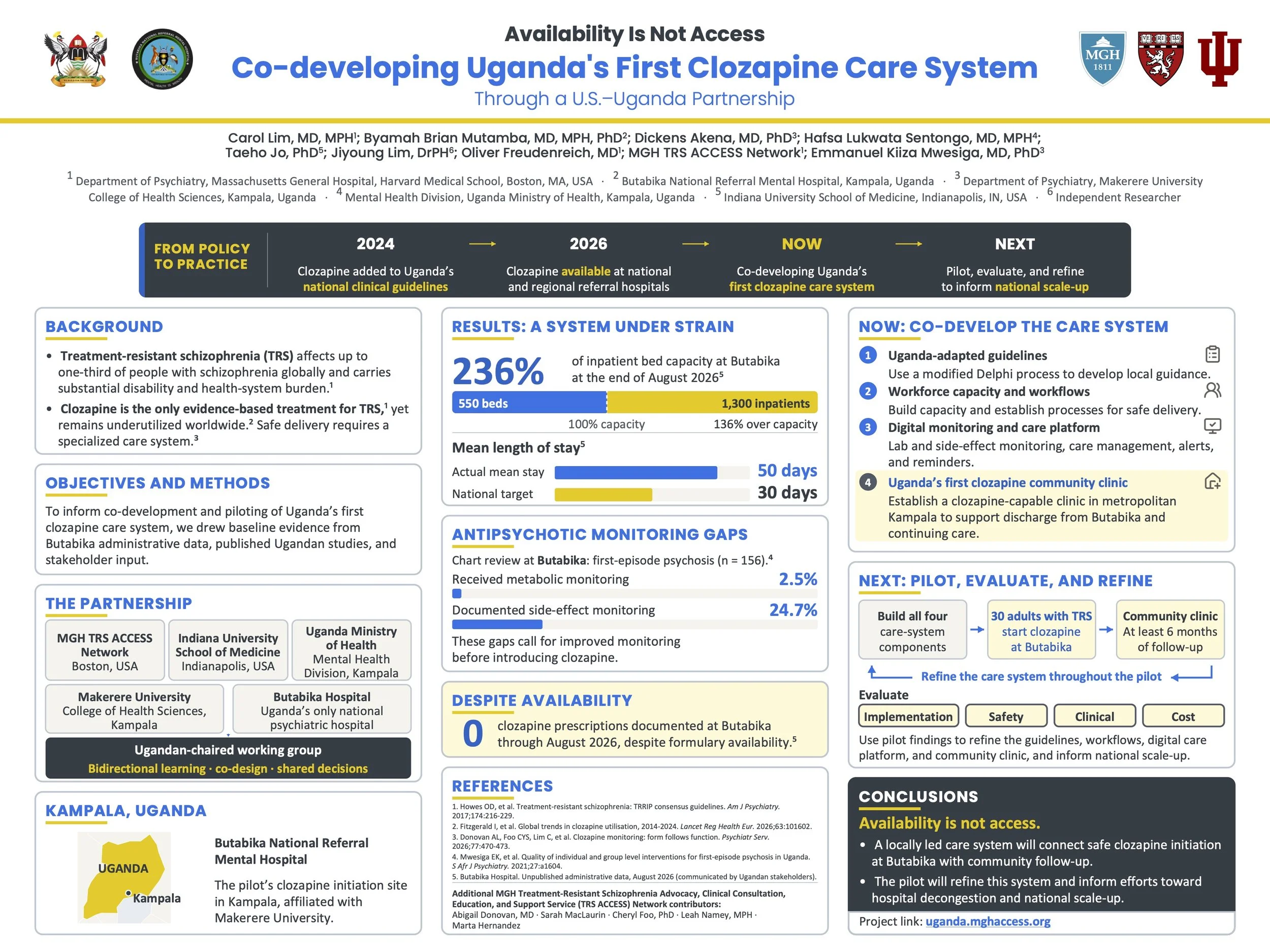
Background: Treatment-resistant schizophrenia (TRS) affects up to one-third of people with schizophrenia globally and is associated with substantial disability and health-system burden. Clozapine is the only evidence-based treatment for TRS, yet remains underutilized worldwide, partly because safe delivery requires specialized care systems. In Uganda, clozapine was added to the national clinical guidelines in 2024, creating an opportunity to build this system. We report baseline evidence informing efforts to co-develop and pilot Uganda’s first clozapine care system.
Methods: The collaboration brings together Massachusetts General Hospital’s Treatment-Resistant Schizophrenia Advocacy, Clinical Consultation, Education, and Support Service (TRS ACCESS) Network, Makerere University, Butabika National Referral Mental Hospital, and the Uganda Ministry of Health. Baseline evidence drew on administrative data, Ugandan studies, and stakeholder input. Through bidirectional learning, a Ugandan-chaired working group will guide co-design. Partners will use a modified Delphi to develop Uganda-adapted guidelines while building workforce capacity, establishing workflows, and adapting a digital platform for laboratory and side effect monitoring, alerts, and reminders. Thirty adults with TRS will initiate clozapine at Butabika and transition to a community clinic for at least six months’ follow-up. Implementation, safety, clinical, and cost experience will iteratively refine the system and inform scale-up.
Results: As of the end of August 2026, Butabika, Uganda’s national psychiatric hospital, is operating at 220% capacity (1,300 inpatients/550 beds), with a 50-day mean stay versus a 30-day target. Published data show monitoring gaps: only 2.5% of patients with psychosis received metabolic monitoring and 24.7% had documented side-effect monitoring, highlighting the need to strengthen monitoring capacity for safe clozapine delivery. Despite formulary availability, no clozapine use is documented at Butabika.
Conclusions: Baseline evidence shows that availability is not access. The pilot will evaluate and refine the co-developed system to enable safe clozapine delivery and inpatient-to-community transition, laying the foundation for hospital decongestion and national scale-up.