
The feasibility of implementing a treatment for mental illness and legal involvement in a Massachusetts state hospital: Qualitative findings from clinicians
Faith Scanlon, PhD (1,2), Isabella Monroe, BS (1), Quinn Lewis, BA (3), Maria Encinosa, BA, BS (2), Catherine Leonard, BS (1), Corinne Cather, PhD (1,2)
1. Massachusetts General Hospital
2. Harvard Medical School
3. Tufts University School of Medicine
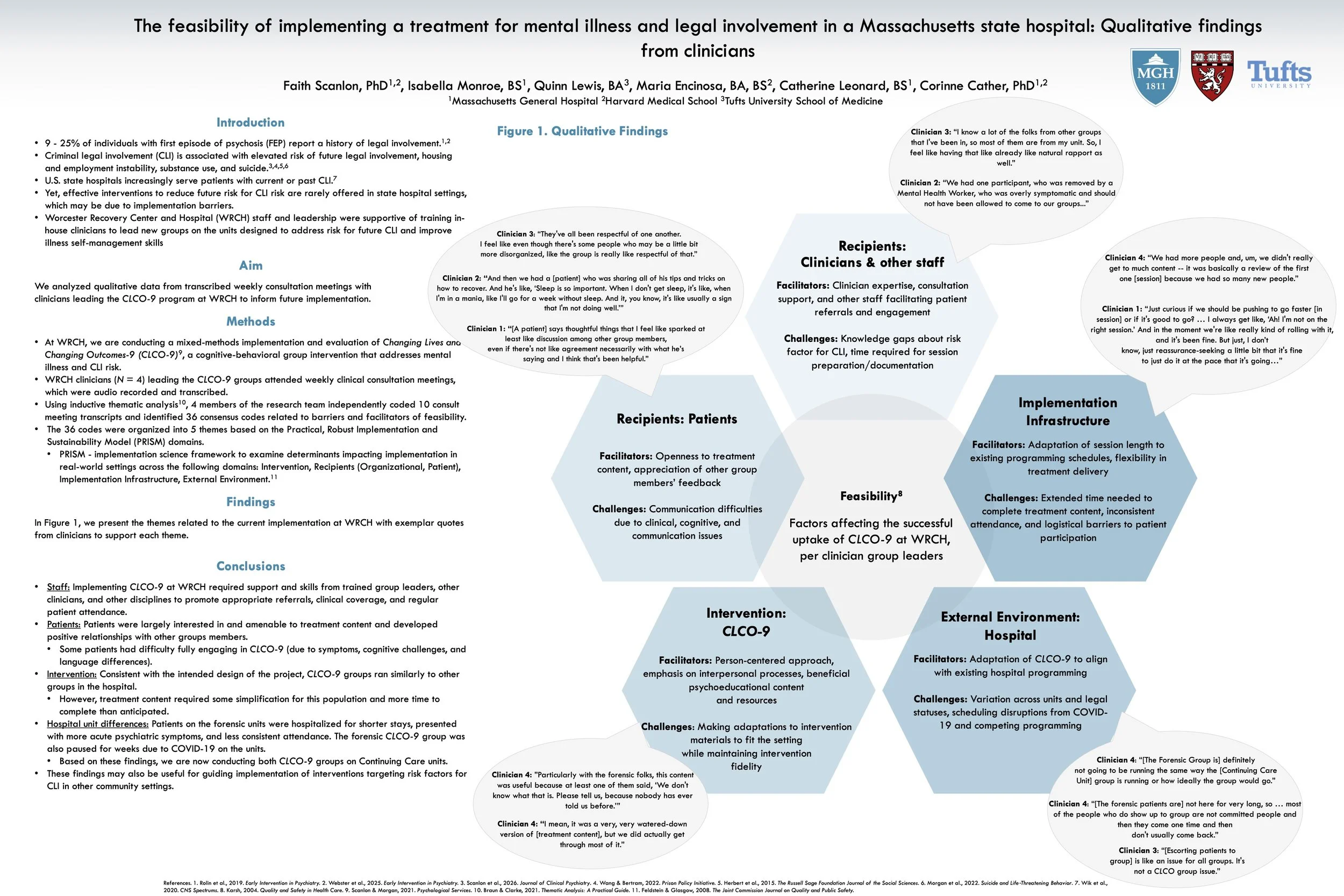
Background: Between 9-25% of individuals with first episode psychosis (FEP) report a history of criminal legal involvement. Criminal legal involvement (CLI) is associated with elevated risk of future legal system involvement, housing and employment instability, substance use, and suicide. Although effective interventions exist to reduce future CLI risk, they are rarely implemented in state hospitals, a gap that has widened as these settings increasingly serve individuals with current or past forensic involvement. To inform implementation, we conducted a qualitative study of state hospital clinicians’ perceptions of implementing a cognitive behavioral therapy intervention targeting mental illness and risk factors for legal involvement (Changing Lives and Changing Outcomes-9; CLCO-9) at Worcester Recovery Center and Hospital (WRCH).
Methods: Four WRCH clinicians led CLCO-9 groups on the hospital’s continuing care (CC) and forensic units. Group leaders participated in weekly clinical consultation meetings to discuss barriers and facilitators to CLCO-9’s feasibility at WRCH. Research team members applied thematic analysis to 10 consultation meeting transcripts, generating 47 implementation-related codes.
Results: Across both units, identified facilitators included: support from other hospital staff, fidelity-congruent adjustments tailoring the intervention to the hospital setting, and clinicians enjoying leading the groups. Some barriers were common to both units (e.g., needing more time than anticipated to complete treatment content). Forensic groups encountered major impediments, including inconsistent attendance due to rapid discharge and high symptom acuity during sessions.
Conclusions: Group leaders found CLCO-9 implementation at WRCH feasible on the CC unit but not on the forensic unit. The CC group was completed successfully; however, the forensic group was discontinued prematurely. These findings are informing efforts to address barriers and strengthen facilitators for CLCO-9 implementation at WRCH and may be useful for guiding implementation of interventions targeting legal involvement risk factors in other community settings.