
Pilot Exploration of a Machine Learning–Based Speech Task in Clinical Evaluation for Psychosis Risk
Hopkins, S.1,2, Buchanan Nguyen, A.1,2, Chaudhry, A.3, Olah, J.3, Weber, A.1,2
1. Center for Early Detection, Assessment & Response to Risk (CEDAR), The Brookline Community Mental Health Center
2.Harvard Medical School Department of Psychiatry, Boston, MA
3. Psyrin
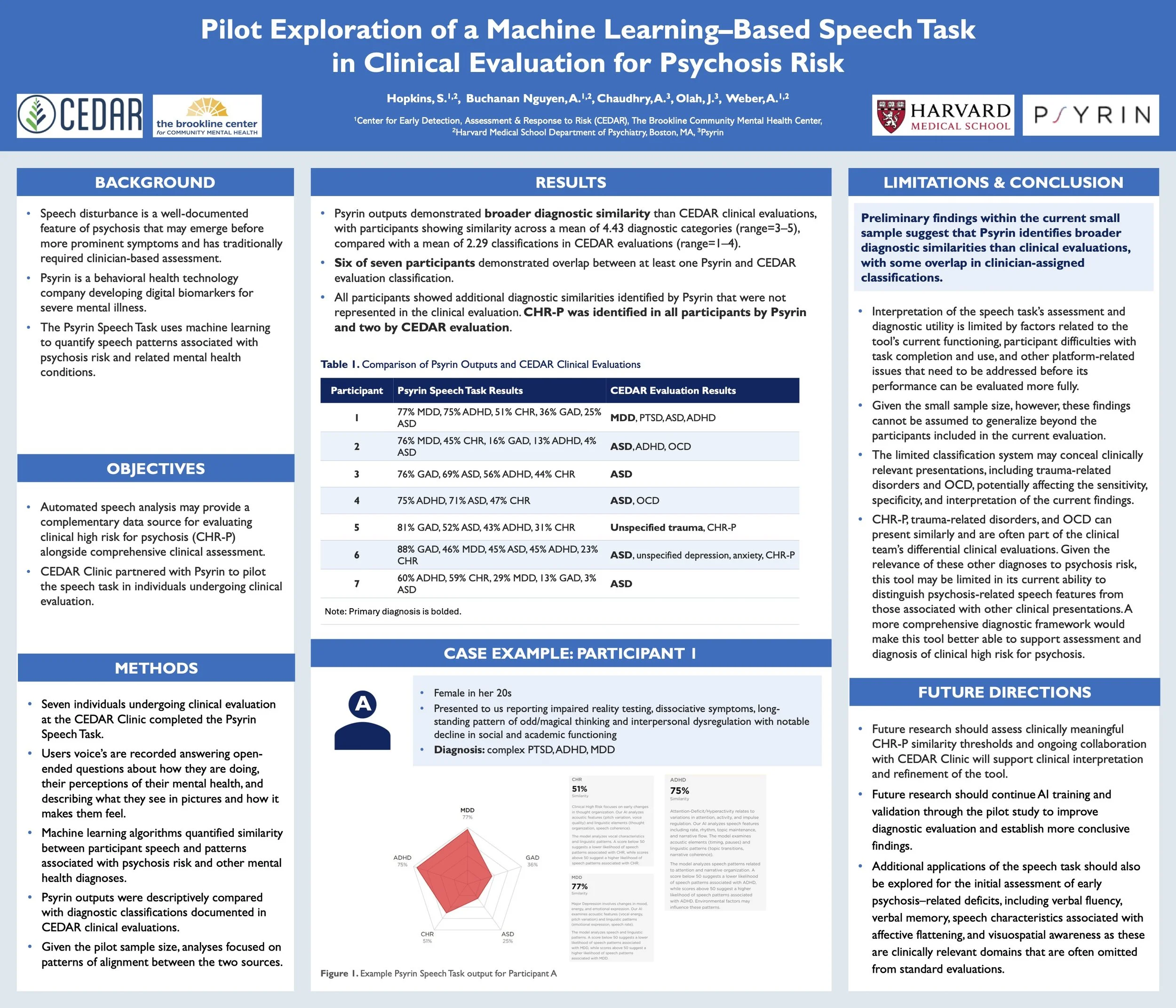
Background: Psyrin is a behavioral health technology company developing digital biomarkers for severe mental illness. The Psyrin Speech Task uses machine learning to quantify speech patterns associated with psychosis risk and related mental health conditions. Speech disturbance is a well-documented feature of psychosis that may emerge before more prominent symptoms and has traditionally required clinician-based assessment. Automated speech analysis may provide a complementary data source for evaluating clinical high risk for psychosis (CHR-P) alongside comprehensive clinical assessment. CEDAR Clinic partnered with Psyrin to pilot the speech task in individuals undergoing clinical evaluation.
Methods: Seven individuals undergoing clinical evaluation at the CEDAR Clinic completed the Psyrin Speech Task. Machine learning algorithms quantified similarity between participant speech and patterns associated with psychosis risk and other mental health diagnoses. Psyrin outputs were descriptively compared with diagnostic classifications documented in CEDAR clinical evaluations. Given the pilot sample size, analyses focused on patterns of alignment between the two sources.
Results: Psyrin outputs demonstrated broader diagnostic similarity than CEDAR clinical evaluations, with participants showing similarity across a mean of 4.43 diagnostic categories (range=3–5), compared with a mean of 2.29 classifications in CEDAR evaluations (range=1–4). See Table 1. Six of seven participants demonstrated overlap between at least one Psyrin and CEDAR classification. All participants showed additional diagnostic similarities identified by Psyrin that were not represented in the clinical evaluation. CHR-P was identified in all participants by Psyrin and two by CEDAR evaluation.
Limitations & Conclusion: Preliminary findings suggest Psyrin identifies broader diagnostic similarities than clinical evaluations, with some overlap in clinician-assigned classifications. Limitations include uncertainty regarding sensitivity and specificity given the limited diagnostic classification system. Future research should assess clinically meaningful CHR-P similarity thresholds and ongoing collaboration with CEDAR Clinic will support clinical interpretation and refinement of the tool.