
Early onset psychosis (EOP) patients show widespread cognitive impairments and specific cognitive lags
Rachel Kraff (1), Margot Austin (1), Montserrat Nieto (1), Dahlia Kirov (1), Emma Deaso (1), Samuel Mathias (1,2), Amanda Rodrigue (1,2), Emma Knowles (1,2), Catherine Brownstein (1), Eugene D’Angelo (1), Joseph Gonzalez-Heydrich (1), David Glahn (1,2), Josephine Mollon (1,2)
1. Boston Children’s Hospital, Boston, MA
2. Department of Psychiatry, Harvard Medical School, Boston, MA
Psychosis with onset <18y, (early-onset psychosis; EOP), is associated with cognitive deficits. Yet, the extent of these deficits is unclear, as prior studies have focused on childhood-onset schizophrenia. Moreover, there are limited data clarifying whether EOP patients show cognitive lags.
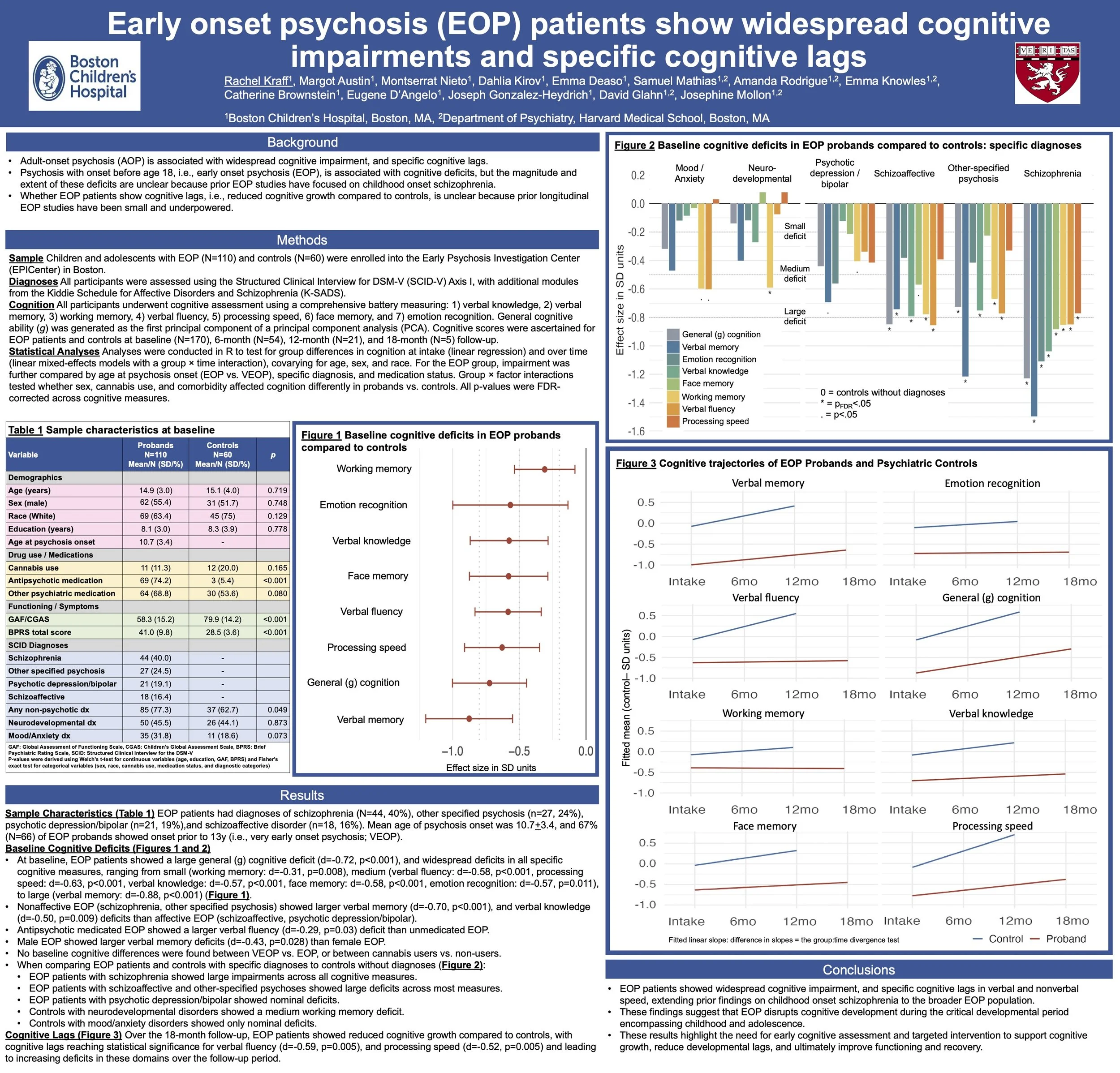
Children/adolescents with EOP (N=110) and controls (N=60) participated. EOP patients had SCID diagnoses of schizophrenia (N=44, 40%), other specified psychosis (n=27, 24%), schizoaffective disorder (n=18, 16%), and psychotic depression/bipolar (n=21, 19%). Age of psychosis onset was 10.5+3.3y, and 67% (N=66) showed onset prior to 13y (very early onset psychosis; VEOP). Participants underwent cognitive assessment measuring: verbal knowledge, verbal memory, working memory, verbal fluency, processing speed, face memory, and emotion recognition. General cognitive ability (g) was generated as the first principal component of a PCA. Data were collected at baseline (N=172), 6-month (N=54), 12-month (N=20), and 18-month (N=5) follow-up. Baseline cognitive deficits, and cognitive lags (time-by-group interactions) in EOP compared to controls were tested.
At baseline, EOP patients showed a large general deficit (d=-0.72, p<0.001) and small to large deficits in all specific measures: working memory: d=-0.31, p=0.008, verbal fluency: d=-0.58, p<0.001, processing speed: d=-0.63, p<0.001, verbal knowledge: d=-0.57, p<0.001, face memory: d=-0.58, p<0.001, emotion recognition: d=-0.57, p=0.011, and verbal memory: d=-0.88, p<0.001. Nonaffective EOP showed larger verbal memory (d=-0.70, p<0.001) and knowledge (d=-0.50, p=0.009) deficits than affective EOP. Antipsychotic medicated vs. nonmedicated EOP showed larger verbal fluency deficits (d=-0.29, p=0.03). Male vs. female EOP showed larger verbal memory deficits (d=-0.43, p=0.028). Throughout 18-month follow-up, EOP patients showed reduced cognitive growth compared to controls, with cognitive lags in verbal fluency (d=-0.59, p=0.005) and processing speed (d=-0.52, p=0.005), leading to increasing deficits over the follow-up period.
EOP patients showed widespread impairment and specific cognitive lags. These findings high-light the need for early identification/intervention to support cognitive growth/reduce developmen-tal lags and improve outcomes.