
Patterns of Coordinated Specialty Care Service Use in Individuals with First-Episode Psychosis
Noah Green, BA¹; Haniya Rizwan¹; Evan Myers, PhD¹,²; Cerelia Liu, BS¹,²; Jason Walsh¹; Jonathan Sugarman¹; Julia Browne, PhD¹,²; Hannah E. Brown, MD¹,²
¹ Wellness and Recovery after Psychosis (WRAP) Program, Department of Psychiatry, Boston Medical Center, Boston, MA, USA
² Boston University Chobanian and Avedisian School of Medicine, Boston, MA, USA
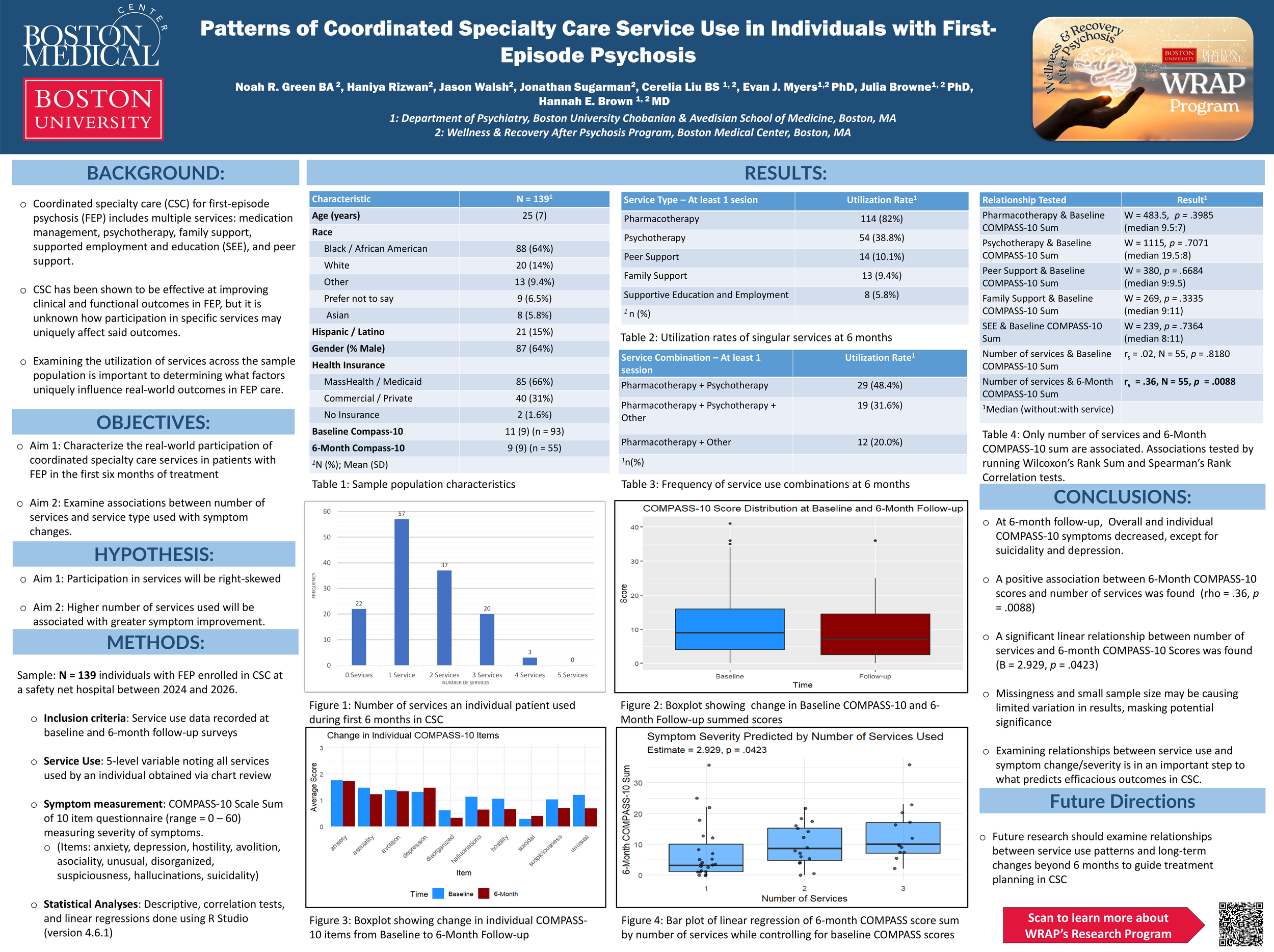
Background: Coordinated specialty care for first-episode psychosis (FEP) includes multiple services: medication management, psychotherapy, family support, supported employment and education (SEE), and peer support. Although coordinated specialty care as a comprehensive package is effective at improving clinical and functional outcomes in FEP, it is unknown how participation in specific services may uniquely affect outcomes. This descriptive study aims to (a) characterize the real-world participation of coordinated specialty care services in patients with FEP in the first six months of treatment, and (b) examine associations between number of services used and symptom changes.
Methods: The sample included 139 individuals with FEP who enrolled in a coordinated specialty care program for FEP between 2024 and 2026. Measures were obtained from the MAPNET standardized battery that is administered to FEP patients at baseline and every six months. Demographics were captured at baseline and service use data were examined at 6 months. Services offered were medication management, psychotherapy, peer support, family support, and supported education and employment.
Results: The sample comprised 139 individuals with FEP with 6-month service use data (64% male, average age = 24.7 years old, 64% Black or African American, 15% Hispanic, 66% publicly insured). At 6 months, 82% had received medication management; 39% psychotherapy; 10% peer support; 9% family support; 7% SEE. Number of coordinated specialty care elements used was 16% zero services; 41% one service; 27% two services; 14% three services; 2% four services. The most frequent combination of services was medication management and psychotherapy (48%), followed by medication management, psychotherapy, and peer support (13%). Associations between service use and symptom outcomes will be presented in the poster.
Conclusion: Results indicate variability in both the number of services received and the specific combination of services. Future research is needed to examine outcomes associated with differential service use profiles.