
From Risk to Resilience: Psychological Resources and Suicide in Early Psychosis : A Preliminary Descriptive Analysis of MAPNET Data
Jeffrey A. Lam (1,2), Gareth Parry (1,2), Norah Mulvaney-Day (1,2), Lynn E. DeLisi (1,2)
1. RISE Psychosis Research Laboratory, Department of Psychiatry, Cambridge Health Alliance
2. Department of Psychiatry, Harvard Medical School
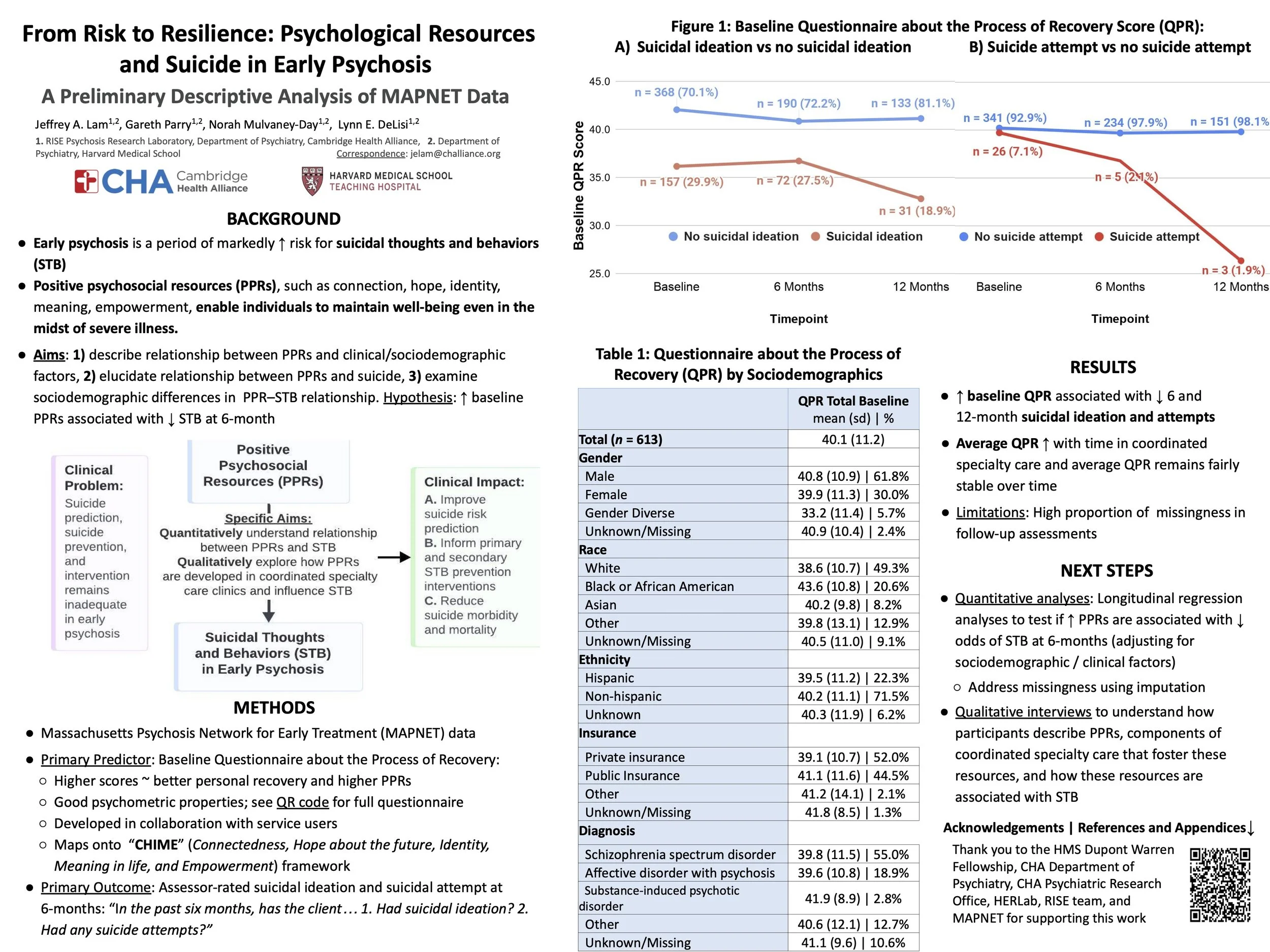
Background: Early psychosis represents a period of markedly elevated risk for suicidal thoughts and behaviors (STB). While risk factors for suicide have been studied extensively, little is known about the relationship between positive psychosocial resources (PPRs; e.g., meaning, hope, social connection) and suicide during this vulnerable period. Furthermore, racial and ethnic minoritized individuals are overrepresented among individuals with severe mental illness yet are understudied, especially in recovery-oriented research. The objectives of this project are to elucidate the relationship between PPRs and suicide; describe the relationship between PPRs, clinical, and sociodemographic factors; and describe how the relationship between PPRs and STB varies by clinical and sociodemographic groups.
Methods: This project leverages data from the Massachusetts Psychosis Network for Early Treatment (MAPNET) consortium. Longitudinal regression analyses will test whether higher PPRs (measured by the Questionnaire about the Process of Recovery; QPR) are associated with lower odds of STB (clinician-rated at 6 and 12-month follow-up) adjusting for sociodemographics, clinical characteristics, service engagement, and clinic. We hypothesize that higher baseline PPRs will be associated with lower STB at 6-month and 12-month follow-up.
Results: Current MAPNET data include complete STB and QPR for 633 (baseline), 316 (6-months) and 237 (12-months) individuals. IRB has been approved by the MA Department of Mental Health, and analyses are ongoing. We anticipate the final poster to include descriptive and preliminary multivariate analyses.
Conclusions: The ultimate goal is to generate research to equitably improve suicide risk prediction by better understanding understudied PPRs across racial/ethnic and sociodemographic groups, and form the basis for future work to reduce the morbidity and mortality associated with STB in this highly vulnerable period and group.