
Integrating Certified Peer Specialists into First-Episode Psychosis Coordinated Specialty Care: Challenges and Best Practices
Lauren Utter (2, 3), Stephen J Fedele (1, 2), Hassan Ramadan, CPS (1, 3), Abigail L. Donovan (2, 3)
1. McLean Hospital
2. Harvard Medical School
3. Massachusetts General Hospital
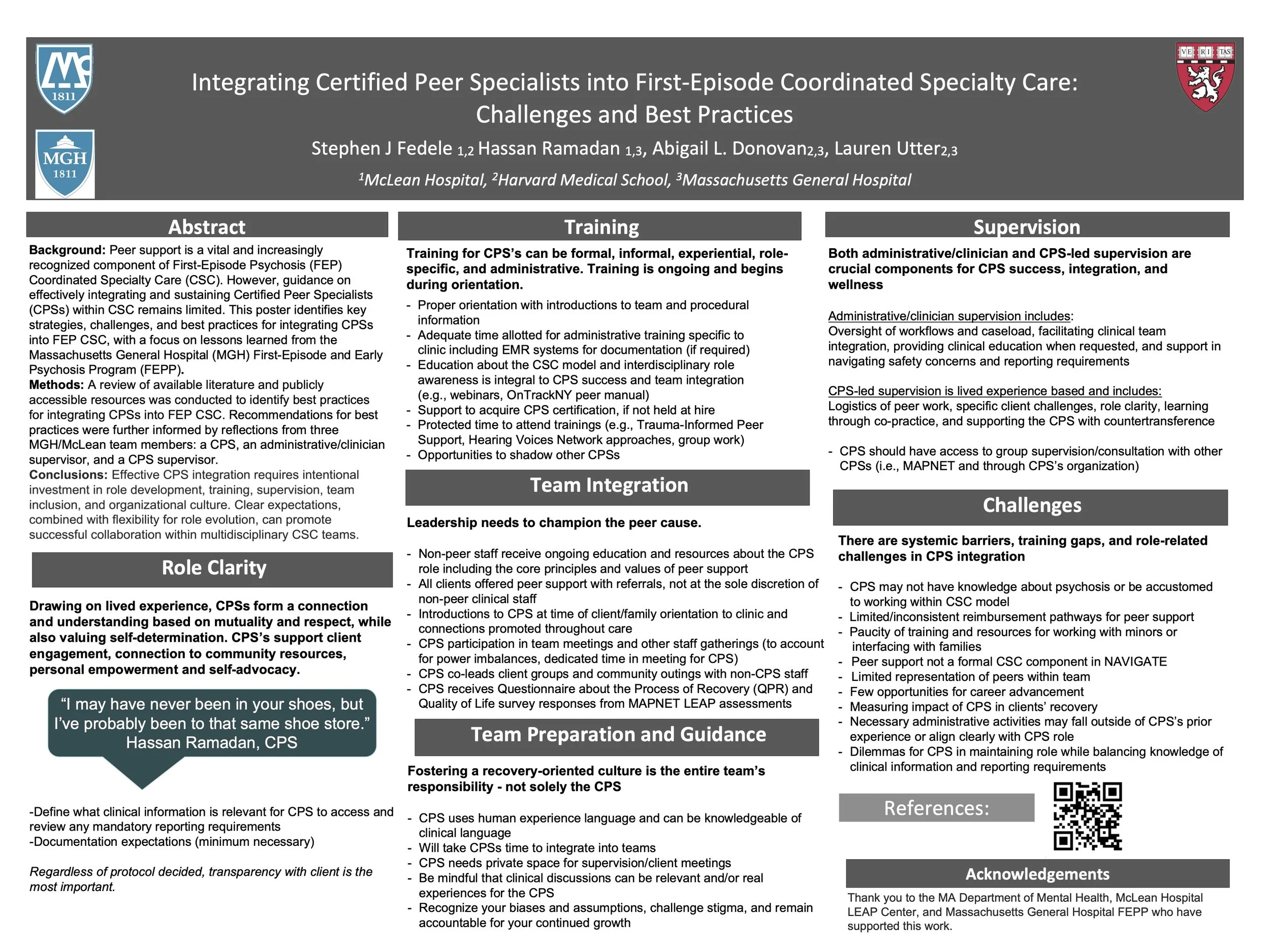
Background: Peer support is a vital and increasingly recognized component of First-Episode Psychosis (FEP) Coordinated Specialty Care (CSC). Drawing on lived experience, Certified Peer Specialists (CPSs) support relationship-building, engagement, connection to community resources, and participant empowerment and self-advocacy. Despite their growing role in FEP services, guidance on effectively integrating and sustaining CPSs within CSC remains limited. This poster identifies key strategies, challenges, and best practices for integrating CPSs into FEP CSC, with a focus on lessons learned from the Massachusetts General Hospital (MGH) FEP clinic.
Methods: A review of available literature and publicly accessible resources was conducted to identify best practices for integrating CPSs into FEP CSC. Resources from OnTrackNY and NAVIGATE were reviewed for approaches relevant to peer support, role development, training, supervision, and team integration. Recommendations for best practices were further informed by reflections from three MGH FEP team members: a CPS, an administrative supervisor, and a CPS supervisor.
Results: Key practices included clearly defining the CPS role while allowing it to evolve with participant and team needs. It also includes providing orientation and role-specific training, consistent supervision, and ensuring opportunities for meaningful coordination between the CPS and other team members. Challenges included navigating role clarity, confidentiality, and clinical documentation requirements while maintaining the distinct role of the CPS. Additional challenges included limited role-specific training on peer support with minors and interacting with family members, despite the inclusion of adolescents and families within many FEP programs.
Conclusion: Effective CPS integration requires intentional investment in role development, training, supervision, team inclusion, and organizational culture. Clear expectations, combined with flexibility for role evolution, can promote successful collaboration within multidisciplinary CSC teams. OnTrackNY and NAVIGATE CSC model resources, combined with lessons from the MGH FEP clinic, provide practical strategies for programs seeking to establish or strengthen CPS roles in FEP care.