
Bridging Language Gaps and Expanding Capacity for the Non-Clinical Mental Health Workforce with Youth Mental Health First Aid for Spanish-Speaking Communities
Joey Rodriguez¹,², Melanie Maldonado¹,², Kelsey Johnson, MPH¹,², Olivia Helfrich-Tapia¹,², & Michelle Friedman-Yakoobian, PhD¹,²
¹ Psychosis Research Program, Beth Israel Deaconess Medical Center, Boston, MA
² Department of Psychiatry, Harvard Medical School, Boston, MA
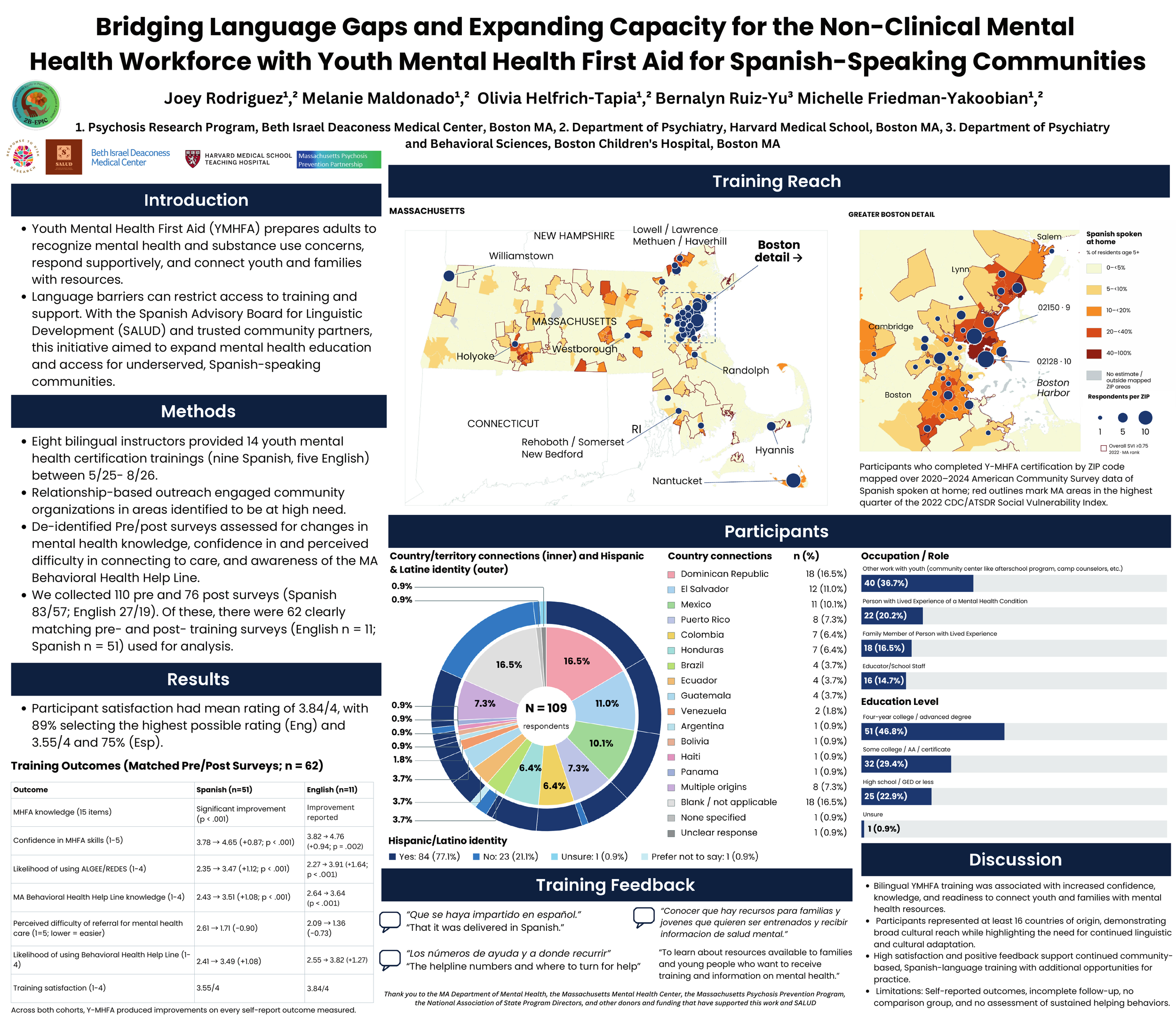
Background: Youth Mental Health First Aid (YMHFA) trains adults to recognize mental health and substance use challenges, respond supportively, and connect youth and families with resources. Language barriers can limit access to training and behavioral health resources. With grant funding from the National Association of State Mental Health Program Directors, the Massachusetts Department of Mental Health, in partnership with the Spanish Advisory Board for Linguistic Development (SALUD), sought to expand free YMHFA training in Spanish and English and develop bilingual instructors.
Methods: Bilingual YMHFA instructors were trained and free trainings were provided in Massachusetts from May 2025–June 2026. Relationship-based outreach engaged trusted community partners, including youth-serving agencies, schools, healthcare and social service organizations, law enforcement, legal aid, child welfare, and faith-based organizations. Fourteen sessions were delivered (nine Spanish; five English). Pre/post questionnaires assessed knowledge, confidence, helping actions, referral barriers, Behavioral Health Help Line awareness, and training reactions.
Results: Overall, 110 participants completed pre-training and 76 post-training surveys (English: 27/19; Spanish: 83/57; 69% post-training response rate), representing at least 16 countries of origin and diverse community-facing roles. Confidence in three key MHFA skills increased significantly in both cohorts (English: +0.67 on a 5-point scale, t=-4.20, p=.002; Spanish: +0.67, t=-6.72, p<.001). Participants also reported greater likelihood of taking helping actions. Among Spanish-speaking participants, perceived difficulty referring someone to professional support decreased from 2.56 to 1.63. Behavioral Health Help Line awareness increased in both cohorts, with particularly important gains among Spanish-speaking participants, who had lower baseline awareness.
Conclusion: Relationship-based outreach and adapting trainings to community needs supported engagement and community partnerships. Participants reported increased confidence and readiness to respond to mental health concerns and connect individuals with resources. Findings support continued investment in linguistically accessible mental health education, bilingual training capacity, and trusted community partnerships to expand early mental health support.