
Co-Creating Foundations for Collaborative Community Health Processes: A Synthesized Mad-Indigenous Monitoring and Evaluation Framework
Vera Muñiz-Saurré, MPH, CPS¹; Natalia Nodiff, CPS; Sherry Yuan, CPS; Kaiyote Wingard; & Lionel Frechette, CPS
¹ Beth Israel Deaconess Medical Center, Boston, MA
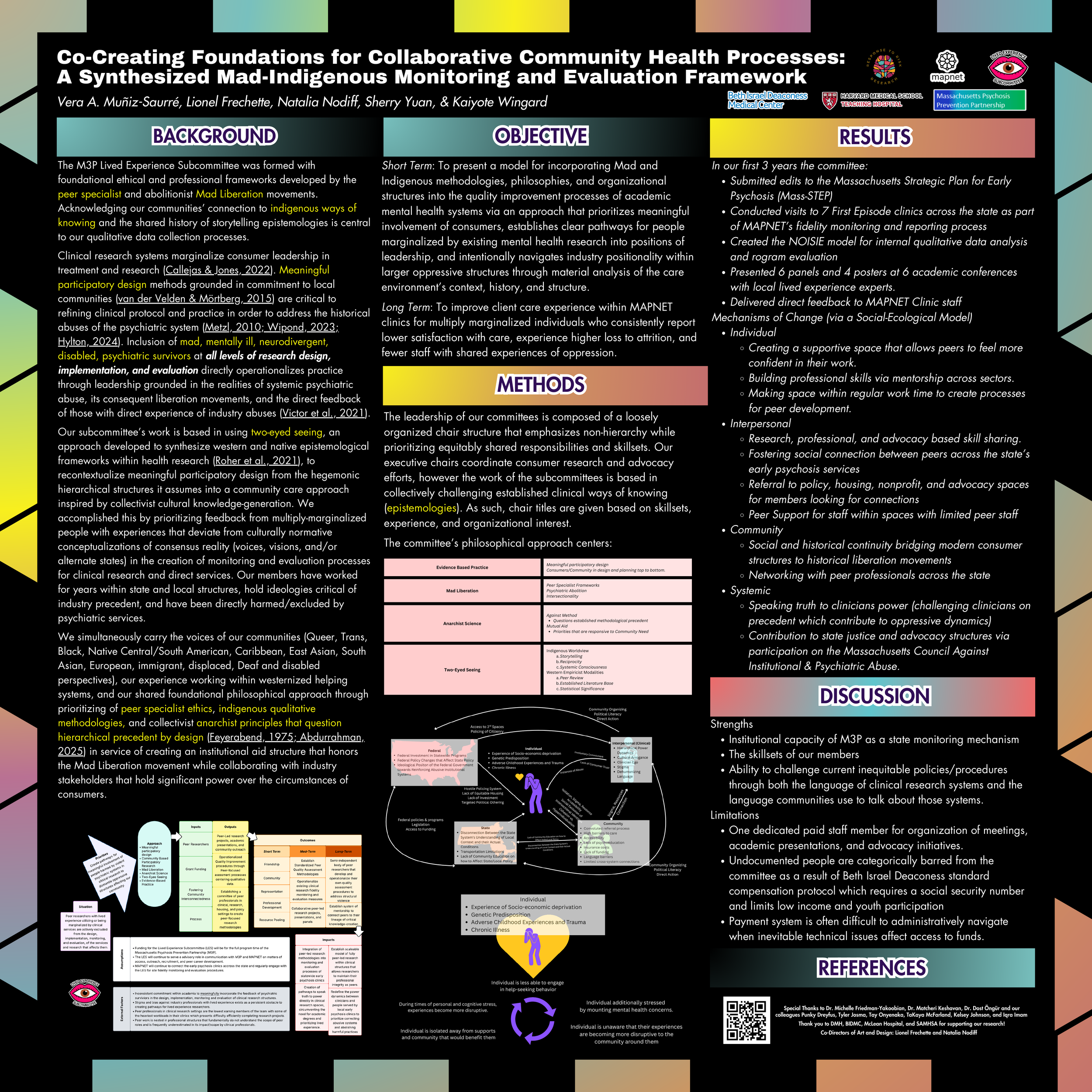
Background: Clinical research systems marginalize consumer leadership in treatment and research. Meaningful participatory design methods grounded in commitment to local working-class communities are critical to refining clinical protocol and practice in order to address the historical abuses of the psychiatric system. Including mad, mentally ill, neurodivergent, disabled, psychiatric survivors at all levels of clinical research design, implementation, and evaluation allows for direct operationalization of practice through leadership grounded in the history of the Mad Liberation and Psychiatric Survivor movements and for direct feedback from those who have experienced industry abuses firsthand.
Methods: The leadership of our committees is composed of a loosely organized chair structure that emphasizes non-hierarchy while prioritizing equitably shared responsibilities and skillsets. Our executive chairs serve as a way of maintaining organization, however the work of the subcommittees is based in mutual effort towards challenging established clinical ways of knowing (epistemologies) which historically exclude and marginalize consumers regardless of experience and industry certifications through development of quality improvement research methodologies. Through this approach, we recontextualized meaningful participatory design by decentering the precedent of hegemonic hierarchical structures by centering development of our own foundational processes through collective synthesis of established peer specialist and anarchist epistemologies. The committee’s approach centers building capacity within our communities to support ourselves in the process of building epistemic infrastructure in parallel to the options available to us and develop standardized monitoring and evaluation processes using anarchist principles that challenge hierarchical methodological precedent by design.
Results: In our first 3 years, our lived experience research team has accomplished the creation of our own assessment, project design, implementation, and evaluation philosophy and approach to advocate for consumers both directly served and systemically excluded from early psychosis care spaces. The core of this is explored through logic models to create a roadmap of the healthcare ecosystem and case examples of how those models are used in the creation of the tools created by the committee (environmental scan guide implemented via MAPNET fidelity interview process, NOISIE Analysis reporting procedure, and interview structures designed to optimize qualitative data collection for peer researchers engaging clinical staff).
Discussion: The iterative work our committee has accomplished over the past 3 years has built a peer community network, a standard set of practices, and core philosophical approach to address the specific interconnected systems within psychiatric settings that contribute to inequities in the care experience of multiply-marginalized people. Through our collaborative approach that centers community perspectives, our intent is to standardize representative participatory methodologies and practices in the regular monitoring processes of MAPNET via the model we have developed in collaboration with the clinical research staff within MAPNET clinics.