
Theoretical and Empirical Support for Implementation of Mentalization Based Interventions for Parents and Caregivers of CHRp Youth
Drew Madore, PsyD¹; Yves Isnor, PsyD¹; Raquelle Mesholam-Gately, PhD¹
¹ Psychosis Research Laboratory, Recovery in Shared Experiences (RISE), Department of Psychiatry, Cambridge Health Alliance, Harvard Medical School
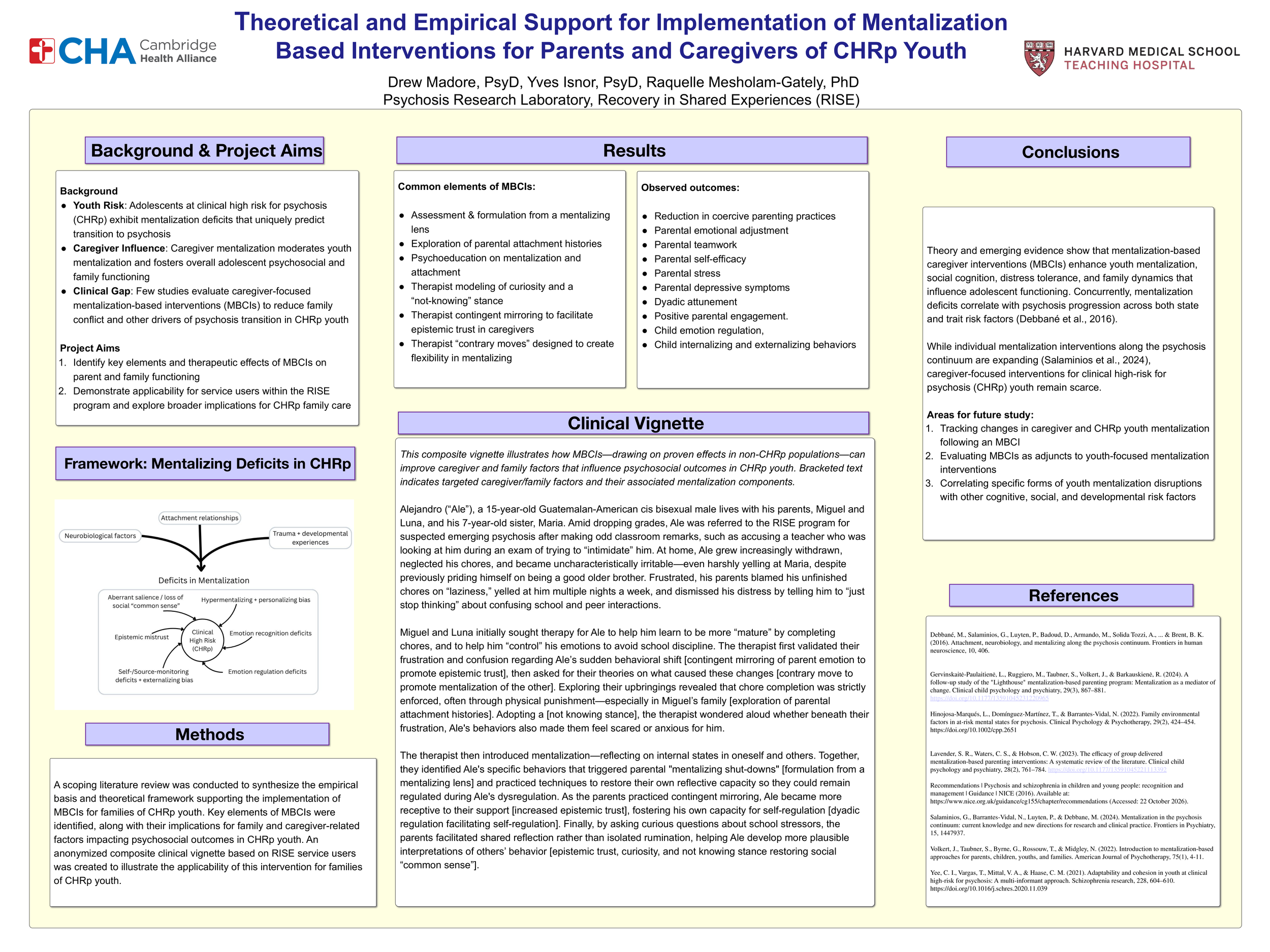
Background: Adolescents at clinical high risk for psychosis (CHRp) have been found to exhibit deficits in mentalization, with said difficulties also being identified as unique predictors of transition to psychosis in CHRp populations. Parent/caregiver mentalization has been posited as a key moderator of child mentalization, in addition to promoting greater overall familial functioning and adolescent psychosocial functioning. However, there are few studies examining the efficacy of mentalization based interventions for parents and caregivers of CHRp youth, and their potential for reducing family conflict and other drivers of transition to psychosis in CHRp youth. In light of the demonstrated links between family functioning, caregiver mentalization, and youth psychopathology, there is a need to examine the effects of a mentalization based caregiver intervention (MBCI) in families of youth designated as CHRp.
Methods: A systematic literature review was conducted to synthesize the empirical basis and theoretical framework supporting the implementation of an MBCI for families of CHRp youth. Additionally, an anonymized composite clinical vignette based on RISE service users was created to illustrate the applicability of this intervention for families of CHRp youth.
Results: Studies demonstrated that caregiver-focused mentalization based interventions correlate with reductions in child/adolescent psychopathology, improvements in adolescent psychosocial functioning, reductions in parent/caregiver stress, and improvements in familial functioning. Greater degrees of mentalization in parents are also correlated with greater degrees of mentalization and emotion regulation in youth across a wide range of diagnostic presentations.
Conclusion: There is a strong theoretical basis and emerging empirical evidence supporting the link between MBCIs in promoting improved mentalization, social cognition, and decreased distress in youth, providing a strong rationale for the utility of these interventions in reducing the risk of transition to psychosis in CHRp youth. Implications for intervention design, assessment of CHRp youth and families, and service delivery are discussed.