
Service Use Patterns and Clinical Outcomes in Coordinated Specialty Care: Examining the Role of Cannabis Use Disorder
Evan Myers, PhD¹,²; Noah Green, BA¹; Isabella Zhang¹; Aviva Geiger Schwarz, MPH¹,²; Haniya Rizwan¹; Jonathan Sugarman¹; Jason Walsh¹; Julia Browne, PhD¹,²; Hannah E. Brown, MD¹,²
¹ Wellness and Recovery After Psychosis (WRAP) Program, Department of Psychiatry, Boston Medical Center, Boston, MA, USA
² Department of Psychiatry, Boston University Chobanian & Avedisian School of Medicine, Boston, MA, USA
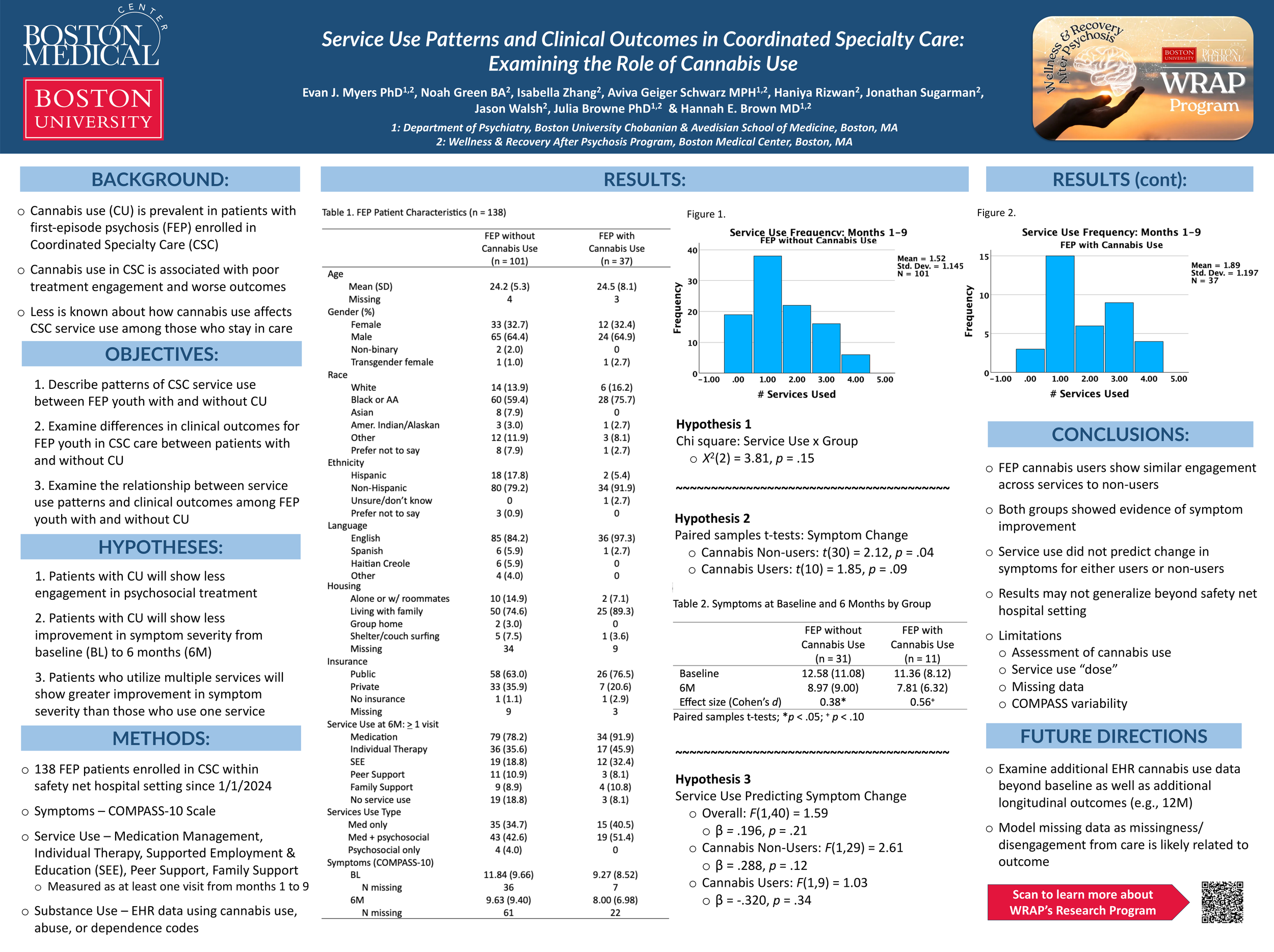
Background: Coordinated Specialty Care (CSC) is an evidence-based treatment model for first-episode psychosis (FEP). Cannabis use in FEP is prevalent and associated with poor treatment engagement and worse clinical outcomes. Less is known about how cannabis use affects use of different CSC services among those who remain engaged in care. Thus, we aim to characterize patterns of service use, clinical outcomes, and how engagement patterns relate to clinical outcomes, comparing those with co-occurring cannabis use disorder (FEP-CUD) and those without (FEP-noCUD).
Methods: Participants were FEP patients who enrolled in a CSC program between 2024 and 2026. Diagnosis of CUD was based on any history of CUD in the patient’s electronic health record. Participants completed the MAPNET Assessment Battery at baseline and at six months, including demographics, service use, and symptom severity (COMPASS-10) measures.
Results: At baseline, FEP-CUD (n = 28) and FEP-noCUD (n = 110) participants were similar in terms of age, race, ethnicity, and health insurance status. Descriptively, a higher proportion of men were in the FEP-CUD group relative to the FEP-noCUD group (79% to 61%). Preliminary descriptive results show that at six months, FEP-CUD participants had lower engagement in all services than FEP-noCUD (medication management: 75% vs. 85%; psychotherapy: 25% vs. 42%; peer support: 7% vs. 11%; family support: 7% vs. 10%; supported education & employment: 4% vs. 6%). FEP-CUD participants also had lower mean symptoms at baseline. Data collection and analysis is ongoing, and changes in symptoms and the relationship between service use and symptoms will be presented in the poster.
Conclusion: Preliminary descriptive results suggest lower service use in the FEP-CUD group. CSC services may need to tailor treatment to address cannabis use to improve FEP care.